<?xml version="1.0" encoding="utf-8"?><feed xmlns="http://www.w3.org/2005/Atom" ><generator uri="https://jekyllrb.com/" version="3.10.0">Jekyll</generator><link href="https://www.sararands.com/feed.xml" rel="self" type="application/atom+xml" /><link href="https://www.sararands.com/" rel="alternate" type="text/html" /><updated>2026-09-01T04:03:28-06:00</updated><id>https://www.sararands.com/feed.xml</id><title type="html">Sara Rands, CMHC</title><subtitle>Therapy for deep thinkers, gifted adults, highly sensitive people, and neurodivergent adults</subtitle><entry><title type="html">Teaching an Autistic Teen to Drive: Expect It to Take a Year</title><link href="https://www.sararands.com/blog/autism-driving/" rel="alternate" type="text/html" title="Teaching an Autistic Teen to Drive: Expect It to Take a Year" /><published>2026-08-30T00:00:00-06:00</published><updated>2026-08-30T00:00:00-06:00</updated><id>https://www.sararands.com/blog/autism-driving</id><content type="html" xml:base="https://www.sararands.com/blog/autism-driving/"><![CDATA[<p>I have helped teach two autistic young people to drive: my daughter and my stepdaughter.</p>

<p>In both cases, it took about a year.</p>

<p>Both are now confident, generally safe drivers. Driving still takes a lot of energy, and they are selective about routes, distance, and complicated freeways. But it has made work, volunteer jobs, friendships, appointments, groceries, family visits, and even some vacations possible.</p>

<p>Outside a few truly transit-friendly cities, not driving can sharply limit adult independence.</p>

<p>That is why my advice to parents of autistic teenagers is simple:</p>

<blockquote>
  <p>Start as soon as it is legally possible, and expect the process to take longer than usual.</p>
</blockquote>

<h2 id="my-experience-is-with-level-1-autism">My experience is with level 1 autism</h2>

<p>My experience here is primarily with level 1 autism, previously called Asperger’s syndrome.</p>

<p>Driving may genuinely be unsafe or out of reach for some autistic people. Parents know their own child better than a blog post ever could.</p>

<p>But it can be hard to know what is possible without giving the young person a long, patient chance to learn.</p>

<p>Slow progress does not necessarily mean they cannot do it. It may just mean they need a year or two instead of a few months.</p>

<h2 id="why-driving-is-hard-for-autistic-learners">Why driving is hard for autistic learners</h2>

<p>Driving requires motor coordination, spatial judgment, rapidly shifting attention, navigation, sensory filtering, and constant prediction of what unpredictable strangers might do.</p>

<p>One autistic adult I worked with clinically drove on the freeway every day, but found billboards surprisingly taxing. Ignoring all that brightly colored visual information required real effort.</p>

<p>Another driver may know every traffic rule but struggle to coordinate steering, mirrors, speed, navigation, and quick decisions at the same time.</p>

<p>The problem may not be knowing what to do. It may be making all the parts happen together, quickly enough, while staying calm enough to think.</p>

<h2 id="what-the-timeline-actually-looks-like">What the timeline actually looks like</h2>

<p>In Utah, a teen can get a learner permit at fifteen. They must hold it at least six months, be sixteen at the time of the road test, and log forty hours of practice driving with a parent, ten of them after dark. Driver education is required for anyone under nineteen.</p>

<p>That forty-hour requirement is worth sitting with. A typical teenager clears it in a few months. An autistic learner may want three or four times that much practice before the road test feels reasonable—and starting at fifteen or sixteen is what makes that possible without a rush at the end.</p>

<p>Our path was ordinary, just slower:</p>

<ul>
  <li>getting behind the wheel on private land, if available</li>
  <li>obtaining a learner’s permit</li>
  <li>practicing in parking lots</li>
  <li>taking commercial lessons, preferably from patient instructors</li>
  <li>doing lots of parental practice in between</li>
  <li>gradually adding traffic, darkness, freeways, and unfamiliar routes</li>
</ul>

<p>Shorter, more frequent practice worked better than occasional marathon sessions.</p>

<p>Twenty minutes several times a week may teach more than two hours spent barely holding it together. Early on, even twenty minutes may be too long. Start with five minutes—or one trip around the parking lot—if that is what the learner can manage successfully.</p>

<p>There may be long plateaus when it appears that nothing is improving. Keep going. Learning is still happening.</p>

<h2 id="start-while-you-still-have-parental-leverage">Start while you still have parental leverage</h2>

<p>Starting early matters partly because parents can still structure regular practice.</p>

<p>At sixteen, you can say:</p>

<blockquote>
  <p>We are driving for twenty minutes today. Then you can have screen time.</p>
</blockquote>

<p>After eighteen, that becomes much harder.</p>

<p>One of the young people I taught was a world-class filibusterer. She could spend enormous energy explaining why she would never need to drive.</p>

<p>Eventually, I asked her to trust the grownups about this one. I meant:</p>

<blockquote>
  <p>You are putting so much energy into arguing that you will never need this.
You would be better served putting some of that energy toward learning it.</p>
</blockquote>

<p>Had we waited for her to initiate the process herself, I do not think she would have learned for many years, if at all.</p>

<p>Today, driving lets her reach work and volunteer opportunities, visit people she cares about, and travel to places she enjoys.</p>

<p>Confidence often comes after practice, not before it.</p>

<h2 id="struggle-does-not-necessarily-mean-something-is-wrong">Struggle does not necessarily mean something is wrong</h2>

<p>I do not assume that struggle means we should stop.</p>

<p>Anxiety deserves attention. Overwhelm can make practice unsafe or counterproductive. But discomfort is also part of learning difficult things.</p>

<p>Sometimes anxiety means the task needs to be smaller. Sometimes it means the learner needs more support. And sometimes it means practicing the same twenty-minute drive again tomorrow.</p>

<p>Respecting distress is not the same as allowing distress to determine the limits of a young person’s life.</p>

<h2 id="gradual-exposure-is-not-the-same-as-flooding">Gradual exposure is not the same as flooding</h2>

<p>One of our first instructors took a brand-new driver onto 700 East, four lanes in each direction.</p>

<p>That was not useful exposure. That was too much, too soon.</p>

<p>The goal is gradual exposure and manageable repetition:</p>

<blockquote>
  <p>I drove for twenty minutes.
I was scared.
I did not crash.
I did not die.
I can do it again.</p>
</blockquote>

<p>This is basically exposure therapy in a Prius.</p>

<p>Of course, driving contains real risk. The lesson is not that nothing bad could ever happen.</p>

<p>It is:</p>

<blockquote>
  <p>I can feel anxious, use my developing skills, and complete the drive safely enough.</p>
</blockquote>

<h2 id="give-the-practice-somewhere-to-go">Give the practice somewhere to go</h2>

<p>For night-driving and freeway hours, we found a great ice cream shop about forty-five minutes away. That gave the drive a built-in reward.</p>

<p>Errands work too. Practice that accomplishes something real is easier to repeat than practice for its own sake.</p>

<h2 id="the-skill-sticks">The skill sticks</h2>

<p>After one of them got licensed, she and her dad drove cross-country to help solidify the skill. She does not currently drive at college, but the skill remains.</p>

<p>The other had gone several years without driving regularly when a car suddenly pulled into her lane. She stopped safely and quickly. The muscle memory was still there.</p>

<p>This is part of why starting early is worth the effort. The work does not expire if the young person does not need it right away.</p>

<h2 id="familiar-and-selective-driving-still-counts">Familiar and selective driving still counts</h2>

<p>Success does not have to mean driving anywhere, anytime, in all types of weather.</p>

<p>Autistic drivers often:</p>

<ul>
  <li>avoid complicated freeways</li>
  <li>stick to familiar routes</li>
  <li>limit distance</li>
  <li>avoid rush hour or snow</li>
  <li>pull over to check navigation</li>
  <li>need significant recovery afterward</li>
</ul>

<p>That is still driving.</p>

<p>Five familiar routes can make an adult life dramatically larger.</p>

<p>The goal is not to perform adulthood exactly like everyone else.</p>

<p>The goal is the largest practical radius of independence available to that person.</p>

<h2 id="the-grit-matters-too">The grit matters too</h2>

<p>Driving is not the only gain.</p>

<p>There is also something powerful about doing the thing you believed you could not do.</p>

<p>An autistic teen may spend months feeling anxious, frustrated, slow, and unlike peers who seemed to learn automatically. Then, eventually, they can drive.</p>

<p>They have evidence that anxiety is not always a stop sign, that slow progress is still progress, and that repetition can change what feels possible.</p>

<p>That evidence transfers. A young person who learns they can tolerate discomfort and keep going has learned something that applies well beyond the car.</p>

<p>And they will know that they practiced something frightening, survived the anxiety, and eventually did what they once thought they could not.</p>

<hr />

<blockquote>
  <p><strong>Dear driving instructors: this is an unmet need.</strong> Many autistic learners can become safe, functional drivers, but need shorter lessons, repeated routes, patient instructors, and a year-long runway instead of a standard course. Autism-friendly driving instruction could change lives.</p>
</blockquote>]]></content><author><name></name></author><category term="autism" /><category term="parenting" /><category term="neurodivergence" /><category term="driving" /><summary type="html"><![CDATA[Learning to drive may take an autistic teen a year or two of short, repeated practice. Starting early creates a wider radius of independence in adulthood.]]></summary></entry><entry><title type="html">What Does Accelerated Resolution Therapy (ART) Feel Like?</title><link href="https://www.sararands.com/blog/accelerated-resolution-therapy/" rel="alternate" type="text/html" title="What Does Accelerated Resolution Therapy (ART) Feel Like?" /><published>2026-08-23T00:00:00-06:00</published><updated>2026-08-23T00:00:00-06:00</updated><id>https://www.sararands.com/blog/accelerated-resolution-therapy</id><content type="html" xml:base="https://www.sararands.com/blog/accelerated-resolution-therapy/"><![CDATA[<p>At Sundance this year I saw <em>See You When I See You</em>, a film based on <a href="https://a.co/d/07jXzbYG">Adam Cayton-Holland’s memoir <em>Tragedy Plus Time</em></a>. The movie unfortunately hasn’t gotten a public release as I write this, but the memoir is also excellent.</p>

<p>One of the things I loved about both was how concretely they portrayed EMDR. You could actually get a sense of what trauma processing looked like. Not just “he went to therapy and worked through his trauma,” but: <strong>What were they doing in there?</strong></p>

<p>And I found myself thinking: I wish people could see Accelerated Resolution Therapy (ART) this way.</p>

<p>ART and EMDR are cousins. Both pair bilateral stimulation with a distressing memory. ART is more structured—there’s a protocol, and a place we’re trying to get to by the end of the session—and it leans much harder on one thing in particular: at a certain point, we start deliberately changing the memory.</p>

<p>Accelerated Resolution Therapy stirs up my old religious evangelism: <em>Oh, that I were an angel, and could have the wish of my heart: that I could cry ART unto every people.</em>  I see how much suffering it can relieve, often with a relatively modest investment of time and money, and part of me wishes I could help everyone experience this.</p>

<p>Not because ART is magic. It doesn’t work for everyone. It isn’t where I like to start with complex trauma. There are times when someone absolutely should not be doing intensive trauma processing.</p>

<p>But especially when there is a fairly discrete trauma—or when someone understands something intellectually and their emotions just haven’t caught up—I often think: <strong>Why not try it?</strong></p>

<h2 id="when-knowing-why-isnt-enough">When knowing why isn’t enough</h2>

<p>A lot of people still picture therapy as mostly talking. You figure out what happened. You understand why you feel the way you do. You notice your patterns. You learn to think about things differently. That kind of top-down work can be enormously useful.</p>

<p>But there are also bottom-up ways of working: therapies that involve what is happening in the body, physical sensations, emotion, imagery, and other kinds of experience that aren’t purely verbal or intellectual.</p>

<p>And sometimes that matters because you already <strong>know</strong>. You know it wasn’t your fault. You know you’re safe now. You know your spouse is not your father. You know this financial situation is not the terrifying one you lived through fifteen years ago. You’ve understood it to death.</p>

<p>And then the plane door closes, your spouse says the thing, the stock market drops, or somebody mentions cancer, and your body is suddenly behaving as though none of that insight exists. This is one of the situations where I especially like Accelerated Resolution Therapy.</p>

<p>ART can feel to me like we are composting different layers of experience together:</p>

<ul>
  <li>
    <p>What you know intellectually.</p>
  </li>
  <li>
    <p>What you feel.</p>
  </li>
  <li>
    <p>What your body does.</p>
  </li>
  <li>
    <p>What images arise.</p>
  </li>
</ul>

<p>Everything gets turned over together. Insight informs emotion. Emotion informs insight. Something richer can come out the other side.</p>

<p>So what does ART actually feel like?</p>

<h2 id="showing-your-brain-the-problem">Showing your brain the problem</h2>

<p>You don’t need to do any special preparation for the ART session itself.</p>

<p>We sit facing each other, close enough that I can see your face and you can see mine. You stay awake, sober, and in charge the entire time.</p>

<p>Plan on more time than a standard therapy hour if we can get it. Ninety minutes is often about right.</p>

<p>We work in short stretches. I’ll ask you to bring something to mind, we’ll do a set of bilateral stimulation, and then we stop and you tell me what you are noticing in your body: sensations, emotions. Not the content of the memory. It isn’t one long descent into the memory. It’s a series of passes with a check-in after each one, and I’m talking with you throughout. You are never in there alone.</p>

<p>You will go through the material more than once. Repetition is how the thing works.</p>

<p>You don’t have to tell me the painful nitty-gritty details of what happened if you don’t want to. ART can work without my knowing the whole story. Most of my clients actually do want to tell me quite a bit, and that’s fine too. If I have some idea of what they’re seeing and feeling, it can help me guide them. But you get to decide what you disclose.</p>

<p>Very broadly, we’re going to bring up the thing your brain is still reacting to.</p>

<p>Sometimes that’s obvious: The car accident. The assault. The cancer treatment. The violence you witnessed.</p>

<p>Sometimes it isn’t.</p>

<ul>
  <li>
    <p>Maybe you have plenty of money now, but spending $100 still feels dangerous.</p>
  </li>
  <li>
    <p>Maybe your religious beliefs changed ten years ago, but some part of you still keeps a running tally of whether you’re “worthy.”</p>
  </li>
  <li>
    <p>Maybe your spouse sounds irritated and suddenly you’re responding to them like they’re the unpredictable parent you grew up with.</p>
  </li>
  <li>
    <p>Maybe a delayed text from someone you’re dating feels like the beginning of the same awful story you lived through with your ex.</p>
  </li>
</ul>

<p>Your logical mind knows the present is different. Your emotional system apparently did not get the memo.</p>

<p>And sometimes you don’t know why you’re reacting at all. That’s okay too.</p>

<p>Sometimes the brain knows before you do.</p>

<p>Memories are messy. When we show the brain the problem, sometimes the story comes in order and sometimes it doesn’t. Sometimes a strange detail becomes important. Sometimes something entirely different shows up the next time through.</p>

<p>That’s okay. The brain has a way of showing us what matters.</p>

<h2 id="the-most-difficult-part">The most difficult part</h2>

<p>Showing your brain the problem is usually upsetting. But we need access to some of the emotional charge in order to work with the memory.</p>

<p>I sometimes compare this to lancing an infected wound. If something painful is trapped underneath the surface, we need enough access to it for healing to happen.</p>

<p>Accelerated Resolution Therapy gives us repeated opportunities to notice what is happening emotionally and physically—the sadness, anger, fear, tightness in the chest, sick feeling in the stomach, pressure in the head, whatever is there—and to use bilateral stimulation as we work back toward a calmer place.</p>

<p>Research on bilateral eye movements gives us some ideas about why this may help, including changes in physiological arousal and in how vivid or emotionally intense a memory feels. We’re still learning why it works.</p>

<p>From the client side, the important part is simpler: we can approach difficult material, notice what comes up, and then help the system settle again.</p>

<p>And something interesting happens as we go through the memory again: <strong>the brain starts changing it on its own.</strong></p>

<p>Different details may stand out. Something that wasn’t there the first time shows up. The scene may organize itself differently. Memory just isn’t as fixed as it feels.</p>

<h2 id="changing-what-the-memory-feels-like">Changing what the memory feels like</h2>

<p>If you’ve seen the first <em>Inside Out</em> movie, you may remember that memories are stored as orbs colored by the emotion attached to them, and that those colors can change. A memory Riley had carried as purely happy turns out to have sadness in it too, and by the end her memories hold more than one color at once. That’s surprisingly close to what we’re working with here.</p>

<p>Memories aren’t static recordings. You can remember something terrible that happened twenty years ago without experiencing it emotionally exactly the way you did when it happened.</p>

<p>ART works with that natural capacity intentionally.</p>

<p>And this is where, as my colleague Dee-Dee put it when we talked about ART on a <a href="https://open.spotify.com/episode/4XVjtAlt9rZ7aBlaS11m0p">podcast</a>, <strong>“It definitely feels a little woo woo.”</strong></p>

<p>We deliberately start changing the scene.</p>

<p>You still know perfectly well what really happened. This is not hypnosis. There are no medications involved. You can think, talk, disagree with me, reject my ideas and come up with your own.</p>

<p>But we play with the scene.</p>

<ul>
  <li>
    <p>Sometimes the bad thing still happens, but this time you have support.</p>
  </li>
  <li>
    <p>Maybe someone you love is there.</p>
  </li>
  <li>
    <p>Maybe your older, stronger self comes in and protects the younger you.</p>
  </li>
  <li>
    <p>Maybe God or another spiritual figure shows up, if that is meaningful to you.</p>
  </li>
  <li>
    <p>Sometimes the bad thing doesn’t happen at all.</p>
  </li>
  <li>
    <p>Sometimes the bad guy gets stopped.</p>
  </li>
  <li>
    <p>Sometimes we abandon reality completely. The accident happens, but instead of hitting something hard, you land on an enormous fluffy mattress. Your logical mind knows there was no mattress. That isn’t the point.</p>
  </li>
</ul>

<p>We’re working with what I sometimes call the <strong>dream brain</strong>—the part of us that understands images and symbols and emotion and doesn’t particularly care whether something could happen in literal reality.</p>

<p>One client once put it especially well: <strong>The brain is kinda dumb.</strong> Your thinking mind knows the improved version didn’t happen. Emotionally, your system may respond to it anyway.</p>

<p>We’re changing what the memory feels like, not what you believe happened. You know the mattress wasn’t there. Nothing we do is meant to give you new beliefs about the facts, and I’m not going to suggest that something happened to you that you didn’t already know about.</p>

<p>Sometimes, after ART, people even have difficulty bringing the old disturbing pictures back. They still know what happened. The facts are intact.</p>

<p>But the emotional experience is more like: <strong>It happened.</strong> <strong>I made it through.</strong> <strong>And it isn’t happening now.</strong></p>

<h2 id="what-if-you-dont-see-pictures-in-your-head-aphantasia-and-art">What if you don’t see pictures in your head? (Aphantasia and ART)</h2>

<p>Some of my neurodivergent clients have aphantasia or limited mental imagery, and sometimes they worry that means ART can’t work for them. Sometimes their ART therapists worry about it too.</p>

<p>I know this one from the inside. My own mental imagery isn’t vivid. ART still works for me.</p>

<p>In my experience, it works fine for clients with limited imagery too. You might narrate the memory internally rather than “watching” it. You might have a sense of what is happening without actually seeing it. You might work more with emotions or physical sensations. Sounds or smells may be much more available than pictures.</p>

<p>Brains represent experience in lots of ways. The memories can still shift.</p>

<h2 id="what-if-you-cant-do-the-eye-movements">What if you can’t do the eye movements?</h2>

<p>Accelerated Resolution Therapy is usually delivered as an eye-movement protocol: you follow the therapist’s hand as it moves back and forth in front of you.</p>

<p>For a lot of people that’s unremarkable. For some it isn’t.</p>

<ul>
  <li>Maybe you get seizures or migraines and tracking a moving object is a bad idea.</li>
  <li>Maybe your eyes don’t track smoothly, or sustained visual focus is genuinely uncomfortable.</li>
  <li>Maybe watching someone’s hand while you’re already flooded with emotion is more than you can manage.</li>
</ul>

<p>Eye movements are one form of bilateral stimulation. There are others—alternating taps, or small handheld devices that buzz side to side. Therapists differ in what they use and what they’re willing to adapt.</p>

<p>If you think this might be an issue for you, ask. The answer will tell you something useful about how a particular therapist works.</p>

<h2 id="what-if-you-cant-tell-what-youre-feeling-alexithymia">What if you can’t tell what you’re feeling? (Alexithymia)</h2>

<p>The check-ins depend on you being able to report something about your internal state. Some people find that easy. Others don’t.</p>

<p>If you have alexithymia—difficulty identifying and naming emotions—or you’ve spent a lifetime not paying attention to your body, “what are you noticing?” can be a genuinely hard question. Some people know something is happening but can’t find words for it.</p>

<p>That’s workable. You don’t need emotional vocabulary. Physical sensations are usually easier: tight, heavy, hot, buzzing, pressure, numb. Location works too—<em>it’s in my throat</em>. Comparison works—<em>more than last time</em>, <em>less than last time</em>, <em>different but I don’t know how</em>. And “I don’t know” is real information, not a failure to participate.</p>

<p>It also tends to get easier as we go. Plenty of my clients notice very little the first time through and considerably more the second. That’s normal. Paying attention to your internal state is an unfamiliar skill, and unfamiliar skills take practice. My impression is that the bilateral stimulation itself makes that layer easier to reach. If the first pass feels like nothing, that’s not a sign this won’t work.</p>

<h2 id="sometimes-there-isnt-one-obvious-memory">Sometimes there isn’t one obvious memory</h2>

<p>Not every problem comes with a convenient traumatic scene.</p>

<p>Maybe you grew up feeling fundamentally alone. There may not be one specific Tuesday afternoon that represents that. But perhaps when you imagine what that experience <em>felt like</em>, what comes to mind is being a very small child shivering alone in a cold cave. We can work with the cave.</p>

<p>Sometimes the relevant image comes from somewhere even less literal: a nightmare, a recurring image, something that emerged during another kind of therapy.</p>

<p>I’ve had several clients bring disturbing images that surfaced during ketamine-assisted psychotherapy into later ART sessions. In KAP, the image may have appeared without a clear explanation. In ART, we can deliberately return to it, explore it while the client is sober and directed, and work with what it seems to represent. That often brings insight and resolution.</p>

<h2 id="what-does-it-feel-like-immediately-after">What does it feel like immediately after?</h2>

<p>An ART session itself can be exhausting. People may cry. They may feel grief or anger they’ve been successfully avoiding for years.</p>

<p>But usually people leave feeling lighter rather than cracked open. That containment is one of the things I value about ART.</p>

<p>My own experience of EMDR felt more like opening <strong>all the cans of worms</strong> at once. The heaviness of what happened long ago intrudes on the rest of life until the processing is done.</p>

<p>ART feels more contained to me. We open only one can of worms and then spend the session processing and integrating the worms in that particular can. Which is an unfortunate metaphor if you think about it too hard, but you get the idea.</p>

<p>Particularly when we have the full ninety minutes, the goal is to work thoroughly with what we opened rather than sending someone back into their week with the can sitting open.</p>

<h2 id="what-shifts-afterwards-in-real-life">What shifts afterwards in real life</h2>

<p>Sometimes what happens afterwards looks very ordinary.</p>

<ul>
  <li>You notice an ache in your body, schedule the appropriate medical appointment, and do <strong>not</strong> spend the next three days mentally planning your funeral.</li>
  <li>You can hear irritation in your spouse’s voice without suddenly becoming twelve years old.</li>
  <li>You can be physically present with a safe partner without an old sexual trauma intruding into the room.</li>
  <li>You can take a market downturn seriously without emotionally returning to the period when losing $1,000 actually could have been catastrophic.</li>
  <li>You can date someone new without making them carry the emotional weight of every toxic person who came before them.</li>
  <li>You can walk into a social group without immediately scanning for who is going to humiliate you.</li>
  <li>You can buy the damn dishwasher.</li>
</ul>

<p>One client, who gave me permission to share this, was extremely anxious about an upcoming cruise with her children and grandchildren. Being trapped on a boat frightened her. Flying was also difficult for her. We did ART. She went on the vacation. She had a blast.</p>

<p>Her life got bigger.</p>

<p>That’s the kind of outcome I care about. Not whether someone can give their trauma a distress rating of zero. <strong>Can you live your life?</strong></p>

<h2 id="when-art-isnt-the-right-approach">When ART isn’t the right approach</h2>

<p>Accelerated Resolution Therapy isn’t where I start with everybody.</p>

<p>People with complex developmental trauma can sometimes go blank as they approach difficult material. Some people would describe this as dissociation. Sometimes clients experience it almost literally as a wall: there is something there, but they can’t get past it.</p>

<p>When that happens, I don’t think my job is to defeat the wall. I encourage the person to send the wall gratitude and compassion: it protected them from something they shouldn’t have had to face. It developed for a good reason.</p>

<p>Sometimes acknowledging that helps it soften. Sometimes it doesn’t.</p>

<p>I respect that. The brain knows what it is ready to process.</p>

<p>These clients may need slower work over multiple ART sessions, or a different way of working, perhaps <a href="/kap/">KAP</a> or NARM. This is actually why I trained in <a href="https://narmtraining.com/what-is-narm/">NARM</a>. I wanted good tools for my complex-trauma clients, including the people whose protective systems aren’t going to let us simply walk straight into the painful material.</p>

<p>And sometimes the problem isn’t internal readiness at all. Sometimes someone’s life is actively falling apart. <strong>That is not the moment to excavate trauma.</strong> If a fire is actively burning, you put out the fire. Later you can do the post-mortem about why there was a fire and what might prevent the next one.</p>

<h2 id="why-not">Why not?</h2>

<p>The <em>accelerated</em> in Accelerated Resolution Therapy is there because ART was developed as a brief trauma-processing treatment.</p>

<p>Complex trauma is complex. But relatively discrete trauma really can shift surprisingly quickly.</p>

<p>And that is part of my “why not?” attitude toward this. If you find an ART therapist who takes your insurance, you may be looking at an intake plus a longer trauma-processing appointment for a couple of copays. Even at cash-pay rates, a few hundred dollars and a few hours can be a very reasonable investment if the alternative is continuing to organize your life around something that happened years ago.</p>

<p>A word about the research: ART’s evidence base is young and thin. A <a href="https://journals.plos.org/mentalhealth/article?id=10.1371/journal.pmen.0000123">2024 systematic review</a> by independent researchers found only five studies, two of them randomized. Nobody has yet published a head-to-head trial of ART against the established first-line treatments, so I can’t tell you it works better than they do.</p>

<p>What those studies did find: everyone got better. Symptom reductions were large and consistent, along with improvements in depression, anxiety, and sleep. Reported harms were minor. The reviewers concluded that ART shows real promise, with little risk of harm and a reasonable investment of resources.</p>

<p>What I can tell you is that the better-studied options—prolonged exposure, CPT, trauma-focused CBT—typically run twelve to sixteen sessions and ask a great deal of the person doing them. Most people in the ART studies finished in under four. That difference matters if the alternative is not getting treated at all.</p>

<p>I hope the research continues. I’d like to know more than I currently do.</p>

<p>No one therapy works for everyone. And sometimes what looked like a simple problem turns out to have more layers underneath it.</p>

<p>But this is why ART brings out my old evangelist. I hate the idea of somebody spending ten years avoiding the yard, or the airplane, or dating, or sex, or spending perfectly affordable money, because they don’t know that therapies like this exist.</p>

<p>There are ART-trained therapists all over the country. <a href="https://is-art.org/directory">Find an ART therapist near you.</a> I want more people to know they have options.</p>

<p>Sometimes something terrible happened. You made it through. And your brain may be able to learn that it is over.</p>]]></content><author><name></name></author><category term="trauma" /><category term="Accelerated Resolution Therapy (ART)" /><category term="neurodivergence" /><summary type="html"><![CDATA[What Accelerated Resolution Therapy actually feels like from the inside: what happens in a session, how it differs from EMDR, and what changes afterward.]]></summary></entry><entry><title type="html">Is It Trauma or Neurodivergence? Why You May Not Need to Know</title><link href="https://www.sararands.com/blog/trauma-neurodivergence-why-not-both/" rel="alternate" type="text/html" title="Is It Trauma or Neurodivergence? Why You May Not Need to Know" /><published>2026-08-16T00:00:00-06:00</published><updated>2026-08-16T00:00:00-06:00</updated><id>https://www.sararands.com/blog/trauma-neurodivergence-why-not-both</id><content type="html" xml:base="https://www.sararands.com/blog/trauma-neurodivergence-why-not-both/"><![CDATA[<p>Trauma and neurodivergence can look remarkably similar from the outside. Often we cannot tell which one—or which combination—explains a particular person’s experience.</p>

<p>The useful news is that therapy does not require that answer first.</p>

<h2 id="where-trauma-and-neurodivergence-overlap">Where trauma and neurodivergence overlap</h2>

<p>Both can involve:</p>

<ul>
  <li>sensory overwhelm</li>
  <li>shutdown</li>
  <li>rigidity</li>
  <li>difficulty identifying emotions</li>
  <li>executive-functioning problems</li>
  <li>social disconnection</li>
  <li>intense reactions to criticism</li>
  <li>a strong need for predictability</li>
</ul>

<p>The overlap is close enough that complex trauma (CPTSD) and late-identified autism are regularly mistaken for each other.</p>

<p>So which is it?</p>

<p>Sometimes the answer is fairly clear. There may be an identifiable trauma history. There may be an autism or ADHD diagnosis, or a lifelong pattern of thinking and perceiving that seems less like an injury and more like the way a particular mind has always worked.</p>

<p>Often, though, the answer is less tidy.</p>

<p>Maybe it is trauma. Maybe it is neurodivergence. Maybe it is temperament. Maybe it is the accumulated effect of moving through the world with a nervous system that was rarely understood or accommodated.</p>

<p>Very often, it is more than one of these.</p>

<p>And we may never know exactly how much came from where.</p>

<h2 id="trauma-is-a-compassionate-framebut-not-a-complete-explanation">Trauma is a compassionate frame—but not a complete explanation</h2>

<p>One of the gifts of trauma-informed thinking is that it replaces a shaming question—</p>

<blockquote>
  <p>What is wrong with you?</p>
</blockquote>

<p>—with a more compassionate one:</p>

<blockquote>
  <p>What happened to you?</p>
</blockquote>

<p>Behaviors that once looked irrational or self-defeating can begin to make sense as adaptations. Hypervigilance, emotional shutdown, perfectionism, people-pleasing, and disconnection from the body may have helped someone survive an environment that did not feel safe.</p>

<p>That reframing can be enormously relieving.</p>

<p>But any useful framework can become too totalizing.</p>

<p>Not every enduring difference is the result of trauma. Not every sensitive nervous system was created by poor parenting or relational injury. Not every difficulty with attention, emotion, sensory input, or social connection can be traced back to something that went wrong.</p>

<p>Sometimes a person is simply born with a nervous system that takes in more, reacts more strongly, or organizes information differently.</p>

<p>Sensory sensitivity varies across species, which suggests these differences are not purely a product of human family dynamics.</p>

<h2 id="neurodivergence-is-not-traumabut-living-with-it-can-become-traumatic">Neurodivergence is not trauma—but living with it can become traumatic</h2>

<p>Inborn differences can intersect with trauma.</p>

<p>A highly sensitive child may be overwhelmed by experiences that another child barely notices. A <a href="/blog/giftedness/">gifted</a> child may be admired for what they can do without feeling deeply understood. An autistic child may repeatedly receive the message that their natural communication, movement, or sensory needs are inconvenient. A child with ADHD may accumulate years of criticism for inconsistency they do not yet know how to manage.</p>

<p>The wiring itself is not the trauma.</p>

<p>But chronic mismatch can create shame, loneliness, masking, self-doubt, and protective adaptations around that wiring.</p>

<p>This is where the categories become difficult to separate. A biological difference may increase vulnerability to certain injuries. Those injuries may then intensify traits that were already present.</p>

<p>Autistic burnout is a good example. The exhaustion, loss of skills, and heightened sensory sensitivity that can follow long periods of masking are not purely trauma and not purely neurodivergence. They are what happens when a nervous system spends years working against itself to meet expectations it was never built for.</p>

<p>Adults identified as autistic or ADHD later in life often arrive with decades of this accumulation already in place—and sometimes with a history of diagnoses that never quite fit.</p>

<p>There can be real pain without a clear villain.</p>

<p>NARM uses the phrase <strong>environmental failure</strong>, which leaves room for a much broader understanding than “your parents caused this.” The environment includes family, school, culture, poverty, illness, social exclusion, inadequate information, and simple bad luck.</p>

<p>Parents can be loving, devoted, and good enough—and still fail to understand a child perfectly. Children can be genuinely hurt without their parents having been neglectful or uncaring.</p>

<p>Parenthood is harder than it looks. Perfect attunement is not possible, and it is not what children need.</p>

<h2 id="distress-is-not-always-evidence-of-harm">Distress is not always evidence of harm</h2>

<p>Concern about trauma can spill into worry about ordinary struggle.</p>

<p>We can see this when watching young children develop. When my children were babies, they fussed during tummy time. But this experience is crucial for physical development.</p>

<p>Watching a baby struggle can feel uncomfortable. You do not leave the baby there after they have clearly become overwhelmed. But you also do not assume that the first frustrated protest means the experience is harmful. You stay close. You engage. You encourage. You let the baby work against gravity for a little while, and you pay attention to when the frustration has become too much.</p>

<p>The goal is not the absence of distress. The goal is supported, tolerable distress that allows capacity to grow.</p>

<p>Some discomfort signals that something is wrong. Some is the ordinary feeling of stretching beyond what is easy. <a href="/2026-08-30-autism-driving/">Good support requires curiosity about which is which.</a></p>

<h2 id="why-therapists-cannot-be-certain-about-origin-stories">Why therapists cannot be certain about origin stories</h2>

<p>Therapy can sometimes become too confident about where a pattern came from.</p>

<p>A current difficulty may fit a compelling explanation about what happened decades ago. That explanation may be emotionally meaningful and clinically useful. But we usually cannot prove it.</p>

<p>Memory is partial. Family members experience the same household differently. Temperament, biology, relationships, culture, chance, and present circumstances all interact.</p>

<p>Therapists can see this vividly when a partner or family member joins a session. The additional perspective may add nuance—but it can also wildly change the working hypothesis. A therapist who had heard only one person’s account may suddenly see a very different relational pattern, sequence of events, or context. It is difficult to infer outside reality from the account of the one person sitting in front of us—not because that person is dishonest, but because every person’s view is necessarily partial.</p>

<p>There is no tape we can rewind to determine exactly why someone became who they are.</p>

<p>Humility is often closer to the truth than certainty.</p>

<p>The more trauma training I have done, the more comfortable I have become using trauma treatment methods without claiming certainty that trauma explains everything. A working theory can be useful without becoming a verdict.</p>

<h2 id="can-trauma-treatment-help-even-when-the-cause-is-uncertain">Can trauma treatment help even when the cause is uncertain?</h2>

<p>In my experience, yes.</p>

<p>I have seen—and personally experienced—that trauma-focused and bottom-up approaches such as the <strong>NeuroAffective Relational Model (NARM)</strong>, <a href="/2026-08-23-accelerated-resolution-therapy/"><strong>Accelerated Resolution Therapy (ART)</strong></a>, and EMDR help neurodivergent clients become more aware of bodily experience, more emotionally fluent, less governed by shame, and more flexible in the ways they respond to themselves and other people.</p>

<p>That is a major reason I pursued this training. I was not primarily looking to become a general trauma specialist. I wanted more powerful tools for helping gifted and neurodivergent clients access the emotional layer of their experience and live from more of their full humanity.</p>

<p>Those changes can be valuable whether the original difficulty arose from trauma, neurodivergence, chronic mismatch, temperament, chronic pain, or several of these at once.</p>

<p>Improvement after trauma treatment does not necessarily prove that trauma caused the problem. It tells us that the pattern responded to that kind of work. Sometimes that is enough.</p>

<h2 id="does-the-distinction-ever-matter">Does the distinction ever matter?</h2>

<p>Yes. Sometimes the underlying mechanism changes the treatment.</p>

<p>OCD is one clear example. General anxiety-reduction strategies can accidentally become reassurance or avoidance. Effective treatment often requires <strong>Exposure and Response Prevention (ERP)</strong>: approaching discomfort, allowing uncertainty, and resisting the behaviors that provide immediate relief but strengthen the cycle over time.</p>

<p>More broadly, it matters whether a person needs healing, accommodation, skill-building, environmental change, or a mix of these.</p>

<p>It matters because neurodivergent people may need to hear:</p>

<blockquote>
  <p>This is not a wound you failed to heal. This may be part of how your mind works.</p>
</blockquote>

<p>And people carrying trauma may need to hear:</p>

<blockquote>
  <p>This pattern once protected you, but it does not have to organize your life forever.</p>
</blockquote>

<p>Still, the distinction does not need to be resolved with certainty before therapy can be useful.</p>

<h2 id="will-therapy-make-me-less-autistic">Will therapy make me less autistic?</h2>

<p>Many gifted and neurodivergent people worry that therapy will try to make them more normal—or that healing will somehow cost them the parts of themselves they value.</p>

<p>But therapy is not going to cure autism, high sensitivity, giftedness, or a fundamentally different way of processing the world. Even if someone wanted it to, therapy simply does not have that kind of power.</p>

<p>What therapy can sometimes change is the suffering that has accumulated around those differences:</p>

<ul>
  <li>shame</li>
  <li>chronic self-doubt</li>
  <li>rigid protective patterns</li>
  <li>difficulty recognizing or tolerating emotion</li>
  <li>disconnection from the body</li>
  <li>fear of closeness</li>
  <li>the belief that one must hide, perform, or constantly compensate in order to belong</li>
</ul>

<p>The aim is not to make a person less sensitive, less gifted, less autistic, or less themselves.</p>

<p>It is to create more room—for emotional fluency, flexibility, connection. More room to tolerate discomfort without being ruled by it. More room to use an unusual mind without being trapped inside its defenses.</p>

<p>We may never know exactly what came from wiring, what came from trauma, and what developed through years of mismatch.</p>

<p>But we do not need certainty before we begin.</p>

<p>We can stay curious. We can try what helps. We can notice what changes.</p>

<p>And a life that once felt narrow, fixed, or hopeless can become larger.</p>]]></content><author><name></name></author><category term="giftedness" /><category term="neurodivergence" /><category term="trauma" /><category term="therapy" /><category term="autism" /><summary type="html"><![CDATA[Trauma and neurodivergence can look remarkably similar. Why therapy can be useful before you know which one explains your experience.]]></summary></entry><entry><title type="html">Gifted Adult Loneliness: Finding Friends Who Understand You</title><link href="https://www.sararands.com/blog/gifted-loneliness/" rel="alternate" type="text/html" title="Gifted Adult Loneliness: Finding Friends Who Understand You" /><published>2026-08-09T00:00:00-06:00</published><updated>2026-08-09T00:00:00-06:00</updated><id>https://www.sararands.com/blog/gifted-loneliness</id><content type="html" xml:base="https://www.sararands.com/blog/gifted-loneliness/"><![CDATA[<p><a href="/blog/giftedness/">Gifted</a> loneliness does not always look like being alone.</p>

<p>A gifted child may be genuinely loved and still not feel fully understood.</p>

<p>The adults around them may be proud of their abilities—even delighted by how impressive they are—without knowing how to meet them when they are overwhelmed, unusually precise, or absorbed in interests no one else shares.</p>

<p>The child can feel celebrated for what they can do while remaining alone with much of their inner experience.</p>

<p>The hurt may not come from one dramatic rejection. It may accumulate through thousands of small moments of being missed.</p>

<h2 id="learning-to-edit-yourself">Learning to edit yourself</h2>

<p>Gifted children often notice very early when their natural way of communicating makes other people uncomfortable.</p>

<p>They may learn to hide what they know, soften their opinions, stop asking so many questions, or pretend not to care quite so much. They may become funny, useful, or impressive rather than vulnerable. Some begin explaining themselves in exhausting detail, hoping that if they provide enough context, someone will finally understand what they mean.</p>

<p>I think of a scene from the first season of <em>Orange Is the New Black</em>. In a flashback, a girl playing a chasing game with neighborhood kids turns out to be faster than the boys, who tell her to slow down and stop showing off. She watches them run after the slower girls instead—the ones letting themselves be caught.</p>

<p>Gifted children may not be able to slow the mind itself. Instead, they learn to conceal its speed.</p>

<p>They filter their references. They leave out the extra layer. They restrain their enthusiasm. They simplify what they say. Beneath the surface, they may be paddling hard: tracking what the other person understands, what might feel threatening, and how much of themselves it is safe to communicate.</p>

<p>These adaptations may help preserve connection. But they also create a particular kind of loneliness: other people are relating to the edited version.</p>

<p>Over time, this self-monitoring can become so automatic that the person no longer recognizes how much effort it requires. They simply assume that friendship means continually translating themselves.</p>

<h2 id="the-relief-of-shared-bandwidth">The relief of shared bandwidth</h2>

<p>Then, occasionally, someone understands.</p>

<p>They catch the reference. They follow the leap. They appreciate the exact distinction you are trying to make instead of asking why it matters. They are delighted rather than overwhelmed when the conversation becomes philosophical, obscure, or unexpectedly specific.</p>

<p>There is less translating and more riffing.</p>

<p>The experience can feel like shared bandwidth or a common language. Sometimes it is almost like discovering a conversational dialect you did not know anyone else spoke.</p>

<p>This is what people mean by an intellectual peer: not someone with matching credentials, but someone whose mind moves at a compatible speed.</p>

<p>I have watched people visibly relax when they realize they will not be shamed for wanting precision or for making a strange reference to a particular book, film, historical event, or lyric. They become more playful. More animated. Less apologetic.</p>

<p>They do not have to defend why the thing is interesting before they are allowed to talk about it.</p>

<p>This kind of connection is not only intellectual. It is attunement.</p>

<p>Someone is tracking not just the content of the conversation, but its pace, associations, humor, and layers. You can feel that they are with you.</p>

<h2 id="wanting-this-is-not-elitist">Wanting this is not elitist</h2>

<p>Many gifted people have received important warnings against elitism.</p>

<p>Those warnings can be useful. Intelligence does not determine human worth. Academic ability is not the only kind of intelligence. Curiosity, kindness, practical skill, creativity, emotional steadiness, humor, generosity, and wisdom all matter enormously.</p>

<p>My husband’s father, who did a good job of raising a gifted kid, put it more practically: in the workplace, you have to be able to work with all kinds of people, and that means you have to be able to get along.</p>

<p>He was right. Getting along broadly is a real skill, and it is not the same as pretending to be someone else. Most of us do not choose our colleagues, our neighbors, or our extended families.</p>

<p>But some gifted people absorb a second message along with the first:</p>

<blockquote>
  <p>Wanting intellectual compatibility is arrogant.</p>
</blockquote>

<p>It is not. And friendship is one of the few places where you do get to choose.</p>

<p>People are allowed to prefer friendships that include a certain kind of humor, emotional depth, shared values, adventurousness, creativity, or intellectual play. Cognitive pace and conversational style are also legitimate dimensions of compatibility.</p>

<p>You are allowed to enjoy people who love precision.</p>

<p>You are allowed to want friends who can follow a fast associative conversation.</p>

<p>You are allowed to seek people who find your interests delightful rather than excessive.</p>

<p>You are allowed to notice that some relationships feel easier than others.</p>

<p>This does not make people who think differently less valuable. It simply means that equal worth does not make all people interchangeable as sources of intimacy and belonging.</p>

<h2 id="friendship-does-not-require-perfect-attunement">Friendship does not require perfect attunement</h2>

<p>Finding good-fit people does not mean insisting that everyone understand everything immediately.</p>

<p>No relationship offers perfect attunement. Friends miss each other, misunderstand references, lose the thread, become tired, and have different interests. Part of healthy connection is being able to tolerate those moments and repair them.</p>

<p>The more useful question may be whether the relationship has enough room for your natural mind.</p>

<p>Can you be precise without being mocked?</p>

<p>Can you become enthusiastic without watching the other person shut down?</p>

<p>Can you explain something unfamiliar without feeling that your entire self must be translated?</p>

<p>Can a misunderstanding be repaired without you being treated as difficult or excessive?</p>

<p>Shared wavelength is not flawless understanding. It is the sense that the other person is interested in finding you.</p>

<h2 id="curating-a-social-world">Curating a social world</h2>

<p>For many adults, friendship is treated as something that simply happens. We meet coworkers, neighbors, parents of our children, or whoever happens to be nearby, and hope that closeness develops.</p>

<p>But gifted adults may benefit from being more deliberate.</p>

<p>You can think about the relationships in which you have felt most relaxed, alive, funny, and understood. What qualities were present? Shared curiosity? Philosophical depth? Fast humor? A niche interest? Emotional openness? A willingness to follow an idea somewhere unexpected?</p>

<p>Then you can look for environments where those qualities are more likely to appear.</p>

<p>That might mean:</p>

<ul>
  <li>interest-based classes or groups</li>
  <li>professional or creative communities</li>
  <li>book clubs</li>
  <li>secular or philosophical organizations</li>
  <li>neurodivergent spaces</li>
  <li>conferences</li>
  <li>online communities</li>
  <li>hosting gatherings centered on the conversations you want to have</li>
</ul>

<p>Being more visible about your real interests also helps compatible people recognize you.</p>

<p>I think of Shel Silverstein’s poem “Masks.” Two people with blue skin both hide it, then spend their lives looking for someone like themselves—only to pass each other without knowing.</p>

<p>It is a perfect image for the cost of successful <a href="/2026-08-16-trauma-neurodivergence-why-not-both/">masking</a>. When you work hard not to look strange, the people who might recognize and delight in your particular kind of strangeness may not be able to find you.</p>

<p>Letting more of yourself show can require courage, especially if you learned early to carefully edit what you communicated. But it is difficult for the other weirdos to recognize you while you are working hard not to look weird.</p>

<h2 id="when-a-few-good-relationships-change-the-rest">When a few good relationships change the rest</h2>

<p>Finding even one or two relationships with that kind of ease can change a person’s entire social world.</p>

<p>When you know that your natural way of thinking is welcome somewhere, you may become less desperate for every person to understand every part of you. You may find it easier to appreciate relationships built around other forms of connection.</p>

<p>Mismatch stops feeling like proof that something is wrong with you.</p>

<p>You can enjoy one friend’s warmth, another’s adventurousness, another’s practical wisdom, and another’s delight in dissecting an obscure philosophical question for three hours.</p>

<p>A varied social world becomes possible because you are no longer asking yourself to disappear inside all of it.</p>]]></content><author><name></name></author><category term="giftedness" /><category term="relationships" /><summary type="html"><![CDATA[Gifted adults may grow up feeling loved but not fully understood. Why finding friends who share your pace and curiosity can bring unexpected relief.]]></summary></entry><entry><title type="html">Giftedness as Obligation: The Relief of Being Average</title><link href="https://www.sararands.com/blog/gifted-and-average/" rel="alternate" type="text/html" title="Giftedness as Obligation: The Relief of Being Average" /><published>2026-08-02T00:00:00-06:00</published><updated>2026-08-02T00:00:00-06:00</updated><id>https://www.sararands.com/blog/gifted-and-average</id><content type="html" xml:base="https://www.sararands.com/blog/gifted-and-average/"><![CDATA[<p>There is a moment in <em>The Princess Bride</em> when the grandson interrupts the story to point out that he had predicted the plot correctly. His grandfather answers: “Yes, you’re very smart. Shut up.”</p>

<p>When I was raising my children, I referenced this quote frequently.</p>

<p>It makes me laugh. But I also hear something unexpectedly healthy in it.</p>

<p>He is not telling the child to hide his intelligence, pretend to be less capable, or make himself smaller so other people feel comfortable. He is saying, affectionately: <em>We know. Your intelligence is already established. But that’s not the most important thing right now.</em></p>

<p>Yes, you are very smart.</p>

<p>Now there is a whole person to develop.</p>

<h2 id="the-pressure-to-live-up-to-potential">The pressure to live up to potential</h2>

<p>Children identified as <a href="/blog/giftedness/">gifted</a> may absorb more than simple information about how their minds work.</p>

<p>They may also hear:</p>

<ul>
  <li>You have enormous potential.</li>
  <li>You are destined to do something important.</li>
  <li>You should be able to excel without much help.</li>
  <li>Your adult life ought to be as exceptional as your test scores.</li>
  <li>It would be a terrible waste not to make full use of your abilities.</li>
</ul>

<p>The message is well intended. Adults see real capacity and want to nurture it.</p>

<p>But “potential” can become less like possibility and more like an obligation.</p>

<p>A gifted child may grow into an adult who feels responsible for producing a life impressive enough to justify the early promise. An ordinary career can feel disappointing. A half-finished book, an abandoned degree, or a season spent caring for children may become evidence of failure. Even a good life may not feel good enough if it does not look proportionately amazing.</p>

<p>How extraordinary should your life be if your childhood IQ was in the 98th percentile? What achievement would finally prove you did not waste it?</p>

<p>There is no way to answer that. The question itself is the problem.</p>

<h2 id="most-of-us-are-average-at-most-things">Most of us are average at most things</h2>

<p>In his essay <a href="https://markmanson.net/being-average">“In Defense of Being Average”</a>, Mark Manson argues for accepting mediocrity when it is the outcome of our efforts—not making mediocrity the goal, but recognizing that most of us will land somewhere near the middle in most areas of life.</p>

<p>That remains true when someone is unusually intelligent.</p>

<p>A gifted person may still be an average athlete, cook, musician, parent, conversationalist, gardener, dancer, or romantic partner. They may be below average at keeping track of paperwork, remembering names, loading the dishwasher efficiently, or knowing what to say at a party.</p>

<p>Even in intellectual life, giftedness does not make someone equally capable in every subject. A person may understand complex abstractions and struggle to learn a language. They may produce brilliant ideas and be an entirely ordinary writer. They may be unusually perceptive and still be wrong—sometimes spectacularly wrong.</p>

<p>None of this cancels out giftedness. It simply places giftedness inside a whole human life.</p>

<h2 id="the-limits-of-being-smart">The limits of being smart</h2>

<p>I think of two very different messages a smart child might receive.</p>

<p>One child learns:</p>

<blockquote>
  <p>You are so smart that you should not have to work.</p>
</blockquote>

<p>Tasks that require repetition are treated as beneath them. Natural ability is praised; effort is unnecessary. When something finally becomes difficult, the child has little experience tolerating frustration, changing strategies, or remaining engaged while feeling incompetent.</p>

<p>Another child learns:</p>

<blockquote>
  <p>Yes, you are smart. That is one important thing about you. Now we are also going to help you develop physically, socially, emotionally, and practically.</p>
</blockquote>

<p>This child may be encouraged to try activities that do not come naturally. They learn to throw a ball even when they are bad at it. They go camping even if they would rather stay home on their computer. They are expected to do chores, build relationships, contribute to their home and community, and gradually become more independent.</p>

<p>Their intelligence is acknowledged securely enough that it does not need to exempt them from ordinary human development.</p>

<p>Carol Dweck’s research points at something similar. In a 1998 study with Claudia Mueller, fifth graders were praised either for being smart or for working hard. The children praised for intelligence went on to prefer easier problems, and after a round of failure they persisted less, enjoyed the work less, performed worse, and were more likely to conclude that they simply lacked ability. They also described intelligence as a fixed trait rather than something that could grow.</p>

<p>Mindset research has had a mixed record since—later attempts to reproduce the praise effect have not always succeeded, and classroom mindset interventions have generally produced smaller results than the early enthusiasm promised. But the core observation matches what I see constantly. When being smart is the thing you are praised for, difficulty starts to feel like disconfirming evidence.</p>

<p>Real life requires capacities that intelligence cannot substitute for:</p>

<ul>
  <li>showing up consistently</li>
  <li>tolerating discomfort</li>
  <li>caring for a body</li>
  <li>maintaining relationships</li>
  <li>doing repetitive tasks</li>
  <li>asking for help</li>
  <li>practicing something badly before doing it well</li>
  <li>continuing when insight has not produced immediate change</li>
</ul>

<p>Understanding what needs to be done is not the same as being able or willing to do it.</p>

<h2 id="when-failure-threatens-an-identity">When failure threatens an identity</h2>

<p>For someone whose identity formed around being smart, effort can feel surprisingly dangerous.</p>

<p>If you are smart, shouldn’t this be easier?</p>

<p>If you need instruction, were you overrated?</p>

<p>If you try sincerely and fail, what will be left of the version of you who was supposed to be exceptional?</p>

<p>I think of a talented artist who illustrated a children’s book and could not enjoy the accomplishment, because she was afraid the finished work would not be amazing. But art does not come with an objective percentile ranking. What if illustrating a children’s book were allowed to be simply interesting, creative, and deeply worthwhile? What might become possible if the work did not have to justify the artist identity?</p>

<p>Avoidance can protect the identity. You cannot discover that you are an average musician if you never take lessons. You cannot be rejected on a date if you never ask anyone out. You cannot write a mediocre first draft if you keep researching the book instead of beginning it.</p>

<p>This is <a href="/2026-08-16-trauma-neurodivergence-why-not-both/">perfectionism</a>, though it does not always look like the tidy, high-achieving version. Sometimes perfectionism looks like a person who never starts. Gifted underachievement is often described as a motivation problem. It may be closer to a protection problem.</p>

<p>The cost is that protecting the identity of being gifted can prevent the person from building a life.</p>

<p>Accepting averageness makes room for <strong>beginner’s mind</strong>: the willingness to encounter something without already knowing how to do it, and without requiring immediate competence as proof that you belong there.</p>

<p>You can take a dance class and stand on the wrong foot. You can learn to date in middle age and discover that much of it feels unnatural. You can make awkward attempts at emotional honesty. You can begin strength training with unimpressive weights. You can create something that does not live up to the version you imagined.</p>

<p>A teacher of gifted children once told me that the most important thing she taught her students was how to fail. For many gifted kids, an imperfect score on a test or assignment is not a routine part of learning but a dysregulating tragedy. Fear of failure keeps them from the experiences that would teach them they can survive it—and many of the best experiences in life are on the other side of that.</p>

<p>Being bad at a new skill is not evidence about your worth or intelligence. It is the ordinary starting point. As Jake the Dog says in <em>Adventure Time</em>, “Dude, sucking at something is the first step to being sorta good at something.”</p>

<h2 id="you-do-not-have-to-keep-proving-it">You do not have to keep proving it</h2>

<p>Some gifted adults also feel a continuing need for other people to recognize their intelligence.</p>

<p>Being misunderstood may feel intolerable. A correction may become a contest. A conversation may become an opportunity to establish expertise. The person may feel diminished when their contribution goes unnoticed or when someone else is more knowledgeable.</p>

<p>This makes sense if being smart became an important source of safety, belonging, or identity.</p>

<p>But it is exhausting to depend on every room reflecting you correctly.</p>

<p>A more secure relationship with giftedness sounds like:</p>

<blockquote>
  <p>My intelligence is real whether or not this person sees it, whether or not it is useful here, and whether or not I am currently succeeding.</p>
</blockquote>

<p>You do not have to insert your full résumé into every conversation. You do not have to win every disagreement. You do not have to demonstrate all the layers you noticed.</p>

<p>Sometimes your intelligence matters enormously. Sometimes another person’s patience, practical knowledge, kindness, courage, or experience matters more.</p>

<p>Either way, you are still you.</p>

<h2 id="what-do-you-actually-want-your-life-to-be">What do you actually want your life to be?</h2>

<p>Releasing the demand to “live up to your potential” does not mean abandoning ambition.</p>

<p>It means ambition can become more personal and less performative.</p>

<p>Instead of asking:</p>

<blockquote>
  <p>What life would be impressive enough for someone with my abilities?</p>
</blockquote>

<p>you can ask:</p>

<ul>
  <li>What holds my attention?</li>
  <li>What kind of work feels meaningful?</li>
  <li>Where do my interests and abilities meet something other people need?</li>
  <li>What <a href="/2026-08-09-gifted-loneliness/">relationships</a> make me more alive?</li>
  <li>What am I willing to practice, even when I am not immediately good at it?</li>
  <li>What kind of ordinary days would I be glad to live repeatedly?</li>
</ul>

<p>Your answers may lead to something conventionally extraordinary.</p>

<p>Or they may lead to satisfying work, a few deep relationships, creative projects no one else sees, service to a small community, a garden, an absorbing hobby, or a home filled with books and people you love.</p>

<p>The value of the life does not depend on how unusual or impressive it looks from the outside.</p>

<h2 id="permission-to-be-fully-human">Permission to be fully human</h2>

<p>Giftedness matters. It can shape how you learn, connect, work, and experience the world. Denying it may require its own kind of self-erasure.</p>

<p>But giftedness is not a mandate to become extraordinary in every dimension—or to build a life that proves the assessment was correct.</p>

<p>You are allowed to be remarkably capable in some ways and thoroughly average in most others.</p>

<p>Yes, you are very smart.</p>

<p>Now you are free to become the rest of yourself.</p>]]></content><author><name></name></author><category term="giftedness" /><summary type="html"><![CDATA[Gifted adults may feel pressure to build an extraordinary life. Accepting that we are average in most ways can create room for curiosity and growth.]]></summary></entry><entry><title type="html">Therapy for Gifted Adults: What Gifted-Informed Therapy Offers</title><link href="https://www.sararands.com/blog/gifted-informed-therapy/" rel="alternate" type="text/html" title="Therapy for Gifted Adults: What Gifted-Informed Therapy Offers" /><published>2026-07-26T00:00:00-06:00</published><updated>2026-07-26T00:00:00-06:00</updated><id>https://www.sararands.com/blog/gifted-informed-therapy</id><content type="html" xml:base="https://www.sararands.com/blog/gifted-informed-therapy/"><![CDATA[<p>Gifted education is not simply about giving children harder worksheets. At its best, it offers an appropriate pace, greater complexity, opportunities to learn alongside similar peers, and an understanding that development may be uneven.</p>

<p>Gifted-informed therapy can serve a similar purpose in adulthood.</p>

<p><a href="/blog/giftedness/">Gifted adults</a> do not necessarily need a special therapeutic modality, or a therapist who is also gifted. But giftedness can shape how a person thinks, feels, connects, works, and experiences the world. When a therapist understands those patterns, therapy may feel less like repeatedly translating yourself and more like being able to begin where you actually are.</p>

<h2 id="a-different-conversational-fit">A different conversational fit</h2>

<p>Many gifted people think quickly, make nonlinear connections, and hold several layers of an experience at once. They may arrive in therapy having already analyzed the problem extensively. They may ask precise questions, notice inconsistencies, and want to understand how the therapist reached a particular conclusion.</p>

<p>A therapist does not need to follow every strand perfectly. No therapist—or relationship—offers perfect attunement. What matters is the ability to lose the thread without becoming defensive, intimidated, or ashamed.</p>

<p>A therapist might say, “I think I lost one of the connections you made. Can we go back?” That is ordinary human misattunement and repair.</p>

<p>The greater problem is when the therapist’s discomfort gets located in the client. Questions may be labeled resistance. Complexity may be treated as unnecessary complication. A fast-moving mind may automatically be interpreted as anxiety, avoidance, or intellectualization.</p>

<p>Sometimes thinking is a defense. Sometimes it is a strength. Sometimes it is simply how the person’s mind naturally works. Often it is all three at once.</p>

<p>Gifted-informed therapy makes room to become curious about which is happening without treating intelligence itself as the problem.</p>

<h2 id="when-the-mind-develops-along-a-different-timeline">When the mind develops along a different timeline</h2>

<p>Giftedness often involves asynchronous or uneven development. A person may have an exceptionally developed cognitive life while having had fewer opportunities to practice emotional awareness, frustration tolerance, practical skills, social confidence, or connection with the body.</p>

<p>This does not mean gifted people are less emotional. Many are also highly sensitive and experience emotion intensely. But a fast, engaging mind can become the place where they feel most at home.</p>

<p>In the early 1970s, public television was going to save the world, and my generation and I were introduced to <em>Mister Rogers’ Neighborhood</em>, <em>Sesame Street</em>, and <em>The Electric Company</em>. I tried <em>Mister Rogers</em>, but I was so bored by the slow pace. Feelings? Boring! Teach me to read so I can learn the secrets of the universe!</p>

<p>But, like every other human, I still had a body and emotions. Later, I had to learn to slow down my mind so there was room to experience them.</p>

<p>For some gifted adults, the mind moves so quickly toward interpretation and problem-solving that the emotional experience barely has time to register. Instead of first noticing hurt, fear, anger, or uncertainty in the body, they may immediately begin explaining what happened, planning what to do, constructing an argument, or researching every possibility.</p>

<p>The thinking may be insightful and useful, but it can arrive so quickly that the person loses contact with the feeling itself and with the information it carries.</p>

<p>Therapy can create enough space to notice what is happening in the body, identify and tolerate the emotion, and then consider the meaning or story attached to it. The goal is not to weaken the mind. It is to develop access to more of the information available to us.</p>

<h2 id="loneliness-and-the-relief-of-a-shared-wavelength">Loneliness and the relief of a shared wavelength</h2>

<p>Giftedness also shapes connection. Some gifted people grow up feeling peculiar or chronically out of step, and learn to slow themselves down, hide their excitement, or avoid appearing “too smart” so that others do not feel threatened.</p>

<p>Equal worth does not mean that every relationship offers the same kind of connection. For someone who has rarely experienced a good cognitive fit, finding it can feel like discovering that a part of themselves they considered excessive is actually welcome.</p>

<p>That kind of <a href="/2026-08-09-gifted-loneliness/">friendship is worth being deliberate about</a>, and it is often something therapy can help a person pursue rather than quietly conclude is unavailable.</p>

<h2 id="intelligence-as-one-part-of-a-whole-person">Intelligence as one part of a whole person</h2>

<p>Gifted people can receive distorted messages about intelligence in either direction. Some are taught that being smart is what makes them special, lovable, or destined for an extraordinary life. Others learn to minimize their intelligence, make themselves smaller, or pretend it does not matter.</p>

<p>Neither approach offers much integration. A healthier message might be:</p>

<blockquote>
  <p>Yes, intelligence is a real and meaningful part of how you are wired. It matters in some settings and not in others. It does not make you more worthy, and it does not exempt you from developing the rest of yourself.</p>
</blockquote>

<p>Therapy can help loosen an identity organized around being impressive. The goal is not to pressure someone to live up to their potential. It is to stop protecting that identity at the expense of a fuller life—which often means <a href="/2026-08-02-gifted-and-average/">making peace with being average at most things</a>.</p>

<h2 id="work-burnout-and-uneven-functioning">Work, burnout, and uneven functioning</h2>

<p>Gifted adults may need complexity, autonomy, novelty, or meaningful work. They may become depleted in environments that require chronic repetition, conformity, or intellectual underuse.</p>

<p>At the same time, giftedness can overlap with <a href="/2026-08-16-trauma-neurodivergence-why-not-both/">ADHD, autism</a>, sensory sensitivity, perfectionism, and executive-functioning difficulties. When high ability occurs alongside a disability or neurodevelopmental difference, the combination is often called twice-exceptional, or 2e. A person may be highly capable in one domain and need genuine support in another.</p>

<p>This can be confusing both internally and externally. Other people may assume that someone who can solve an unusually difficult problem should also be able to manage paperwork, keep a consistent routine, tolerate a chaotic workplace, or complete every ordinary task with ease.</p>

<p>High ability can hide legitimate needs. It can also make it harder for the person to understand and accept those needs without shame.</p>

<p>Gifted-informed therapy can help separate capability from capacity, needed support from avoidance, and meaningful challenge from chronic mismatch.</p>

<h2 id="starting-where-you-actually-are">Starting where you actually are</h2>

<p>At its best, gifted-informed therapy offers a relationship in which a person does not have to be smaller, simpler, continually impressive, or only a brain.</p>

<p>Giftedness is not the whole person.</p>

<p>But when it is an important part of how someone experiences the world, therapy works better when there is room to acknowledge it.</p>

<p>If this sounds like the kind of fit you have been looking for, you can <a href="/">learn more about working with me</a>.</p>]]></content><author><name></name></author><category term="giftedness" /><category term="therapy" /><summary type="html"><![CDATA[Giftedness can shape cognitive pace, emotional processing, relationships, identity, burnout, and therapy fit. Here's what gifted-informed therapy can offer.]]></summary></entry><entry><title type="html">The Serenity Prayer, But Make It a Flow Chart</title><link href="https://www.sararands.com/blog/agency-serenity-prayer/" rel="alternate" type="text/html" title="The Serenity Prayer, But Make It a Flow Chart" /><published>2026-02-20T00:00:00-07:00</published><updated>2026-02-20T00:00:00-07:00</updated><id>https://www.sararands.com/blog/agency-serenity-prayer</id><content type="html" xml:base="https://www.sararands.com/blog/agency-serenity-prayer/"><![CDATA[<p>I first encountered the Serenity Prayer as a kid. It hung on someone’s wall, or Dear Abby introduced it to me. Either way, it lodged itself somewhere in my brain early.</p>

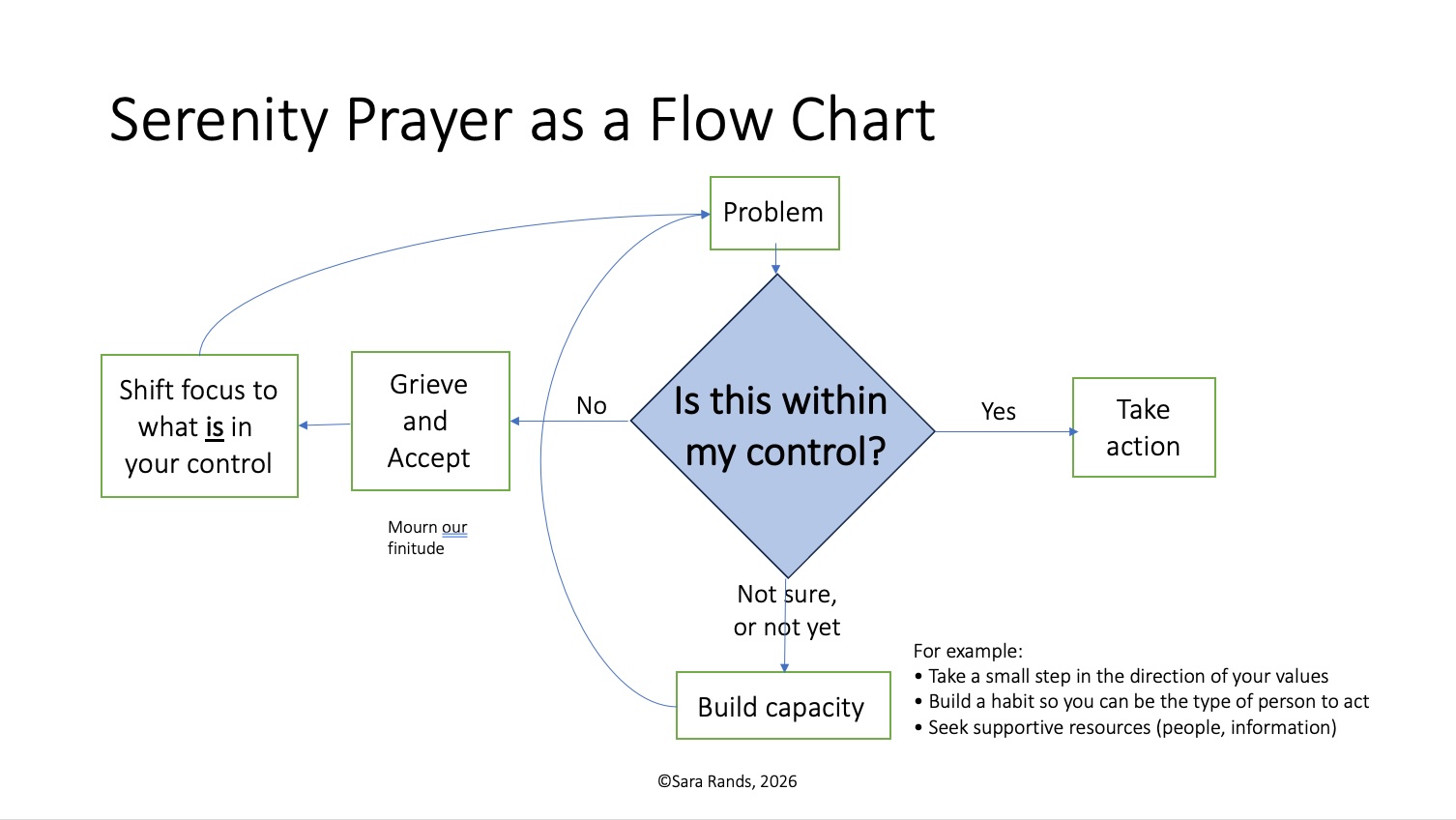
<blockquote>
  <p>Grant me the serenity to accept the things I cannot change,<br />
the courage to change the things I can,<br />
and the wisdom to know the difference.</p>
</blockquote>

<h2 id="why-we-feel-stuck-even-when-we-understand-the-problem">Why We Feel Stuck (Even When We Understand the Problem)</h2>

<p>Years later, as a therapist, I started noticing something.</p>

<p>People often come into my office feeling stuck.</p>

<p>They can explain their situation in exquisite detail. They understand the family system, the politics, the attachment wounds, the economy, their own habits. Insight is not usually the problem.</p>

<p>The problem is misdirected energy.</p>

<p>They are pouring enormous cognitive and emotional effort into things that are not actually movable.</p>

<p>That’s when the Serenity Prayer reappears: not as inspiration, but as a diagnostic tool.</p>

<p>Is this under your control?</p>

<p>That question alone reveals a lot.</p>

<hr />

<h2 id="the-serenity-prayer-as-a-mental-health-tool">The Serenity Prayer as a Mental Health Tool</h2>

<p>There’s also a thinky, logical side of me—the side that survived a computer science degree at forty.</p>

<p>So eventually I translated the Serenity Prayer into a flow chart. Because of course I did.</p>

<div class="blog-chart">
  <img src="/assets/images/serenity-prayer-flowchart.jpg" alt="Flow chart based on the Serenity Prayer asking: “Is this under my control?” If yes, take action. If no, practice grief and acceptance before refocusing on what you can change." loading="lazy" />
  <p class="image-caption">The Serenity Prayer as a flow chart</p>
</div>

<p>Let’s walk through it!</p>

<p>Problems go in.</p>

<p>First question: <strong>Is this under my control?</strong></p>

<p>Not: should it be.<br />
Not: is it fair.<br />
Not: if other people behaved correctly would this be different.</p>

<p>Just: in the world as it exists right now, is this mine?</p>

<p>That question is harder than it sounds (hence “the wisdom to know the difference”). We desperately want more things to be controllable than actually are.<br />
There are feelings here. Disappointment. Anger. Sometimes panic.</p>

<p>But press onward bravely.</p>

<p>If the answer is yes—then <strong>act</strong>.</p>

<p>Usually not dramatically. Not heroically. <strong>Just one small step.</strong></p>

<p>Make the appointment. Have the conversation. Move the money. Stop rereading the text thread. Go for a walk. Apply for the job. Set the boundary.</p>

<h2 id="anxiety-depression-and-self-efficacy">Anxiety, Depression and Self-Efficacy</h2>

<p>Action builds <strong>self-efficacy</strong>, our belief in our ability to act effectively. And self-efficacy is quietly one of the most powerful antidepressants we have.</p>

<p>Anxiety has “do something!” energy. This framework helps aim that energy toward something that might actually improve your life.</p>

<p>Depression collapses possibility. This framework helps locate one movable piece.</p>

<h2 id="grief-acceptance-and-what-you-cannot-control">Grief, Acceptance, and What You Cannot Control</h2>

<p>If the answer is no, then the work shifts.</p>

<p>And this is the part people hate.</p>

<p>If you cannot change it, then the task is <strong>grief</strong>.</p>

<p>Grieving the housing market. Grieving the diagnosis. Grieving the personality of someone you love. Grieving the past. Grieving that you do not get to brute-force reality into something more comfortable.</p>

<p>Acceptance is not approval. It is not pretending harm didn’t happen. It is facing reality as it is. Radical acceptance. And without facing reality, we cannot orient ourselves.</p>

<p>Eventually, after grief has done its work, attention tends to drift back to the next question:</p>

<p><strong>Given reality as it is, what is still mine?</strong></p>

<p>And that is where agency quietly returns.</p>

<hr />

<p>What if you’re not sure whether something can change?</p>

<p>Then <strong>build capacity</strong>.</p>

<p>Maybe you cannot change the situation today. But you can take a small step toward becoming the kind of person who can. Learn a skill. Build a habit. Recruit allies. Strengthen your nervous system. Increase your options.</p>

<p>Agency is not binary. It expands with use.</p>

<hr />

<h2 id="the-psychology-of-agency">The Psychology of Agency</h2>

<p>None of this is new. Decades of research support this idea that mental health improves when our efforts align with what is under our control.</p>

<p>Psychology keeps rediscovering this principle under different names: <strong>self-efficacy, locus of control, learned helplessness, growth mindset, existential freedom.</strong></p>

<p><strong>Acceptance and Commitment Therapy (ACT)</strong> builds entire interventions around acceptance plus committed action aligned with values.</p>

<p><a href="/about/#how-i-work">The NeuroAffective Relational Model (NARM)</a>, a framework I’ve been loving lately, centers adult agency as a core healing mechanism.</p>

<p>Even ancient <strong>Stoicism</strong> boils down to some version of this distinction.</p>

<p>Different centuries. Different jargon. Same core idea: when people act inside their window of control, that window tends to widen.</p>

<p>When people fixate exclusively on what is outside their control, their world shrinks.</p>

<hr />

<p>I also want to say something important here.</p>

<p>If you feel like you don’t have choices, that probably makes sense.</p>

<p>There are real constraints in this world. Trauma can dramatically impact our felt sense of choices, sometimes long before we have language for what happened. Some people begin life with a much narrower slice of control than others. Privilege is real. Health problems, financial constraints, abusive systems—these are not solved by positive thinking.</p>

<p>Self-compassion is usually the first step.</p>

<p>But after compassion, it is worth asking:</p>

<p>Is there a sliver here that is still mine?</p>

<p>Even within constraints, there is often a sliver of movement. The work is learning to find it without denying the constraints.</p>

<p>So if you feel stuck, try running the problem through the filter.</p>

<p><strong>Is this under my control?</strong></p>

<p>If yes, take a small step.</p>

<p>If no, grieve it honestly.</p>

<p>Then look again.</p>

<p>You might be surprised how much clarity emerges.</p>]]></content><author><name></name></author><category term="agency" /><summary type="html"><![CDATA[A therapist explains how focusing on what you can control reduces anxiety, eases depression, and helps you get unstuck.]]></summary></entry><entry><title type="html">When Giftedness Leads to Burnout</title><link href="https://www.sararands.com/blog/gifted-burnout/" rel="alternate" type="text/html" title="When Giftedness Leads to Burnout" /><published>2026-01-20T00:00:00-07:00</published><updated>2026-01-20T00:00:00-07:00</updated><id>https://www.sararands.com/blog/gifted-burnout</id><content type="html" xml:base="https://www.sararands.com/blog/gifted-burnout/"><![CDATA[<p>Many of the people I work with are <a href="/blog/giftedness/">gifted</a>.</p>

<p>They’re quick thinkers. Deep processors. Multipotentialites: people who could have succeeded in many different careers or life paths. They’re competent, resilient, and often admired for their ability to “handle a lot.”</p>

<p>And many of them end up burned out.</p>

<p>This surprises them. It sometimes surprises the people around them. After all, if anyone should be protected from burnout, shouldn’t it be the people who are smart, capable, and adaptable?</p>

<p>In reality, giftedness can be a risk factor for burnout, not a shield against it.</p>

<h2 id="the-hidden-trap-of-being-able-to-do-many-things">The hidden trap of being able to do many things</h2>

<p>Gifted adults often have an unusual ability to adapt. They can learn quickly, perform well, and meet expectations in a wide range of roles. That flexibility opens doors, but it can also create a trap.</p>

<p>Because when you can do many things, it becomes easy to stay in situations that aren’t actually a good fit.</p>

<p>A non-gifted person might hit the end of the road sooner. The mismatch becomes obvious. Performance drops. The job simply doesn’t work.</p>

<p>A gifted person often keeps going.</p>

<p>They adjust. They compensate. They “figure it out.” Externally, things look fine, sometimes even impressive. Internally, something slowly drains away.</p>

<p>Competence delays reckoning.</p>

<h2 id="when-resilience-works-against-you">When resilience works against you</h2>

<p>This pattern is especially common in gifted people who grew up in tough family systems.</p>

<p>People who learned early to:</p>
<ul>
  <li>be responsible</li>
  <li>push through discomfort</li>
  <li>not complain</li>
  <li>not need too much</li>
  <li>stay functional no matter what</li>
</ul>

<p>Add in cultural messages—especially masculine ones—about grit, endurance, and powering through, and internal warning signs become even easier to ignore.</p>

<p>Boredom becomes “normal.”
Dread becomes “just how work is.”
Exhaustion becomes “a personal weakness.”</p>

<p>Instead of being treated as information, these signals are treated as something to overcome.</p>

<h2 id="burnout-isnt-suddenits-delayed">Burnout isn’t sudden—it’s delayed</h2>

<p>Burnout rarely comes out of nowhere.</p>

<p>More often, it’s the end point of years of subtle signals that were overridden:</p>
<ul>
  <li>chronic boredom disguised as stability</li>
  <li>low-grade dread that never quite goes away</li>
  <li>living mostly in your head</li>
  <li>success without satisfaction</li>
  <li>fantasizing about escape rather than growth</li>
</ul>

<p>These aren’t character flaws. They’re misalignment signals.</p>

<p>But gifted people are often very good at ignoring the check engine light—until the car blows up on the side of the road.</p>

<p>That’s when they end up in therapy, saying some version of:</p>

<p>“I don’t understand how this happened. I was doing everything right.”</p>

<h2 id="just-because-you-can-doesnt-mean-you-should">Just because you can doesn’t mean you should</h2>

<p>This is a hard truth for gifted people to learn, especially if their identity has long been built around competence.</p>

<p>Giftedness expands your options.
It also can expand your ability to tolerate the wrong one.</p>

<p>Being able to do something does not mean it’s sustainable.
Being good at something does not mean it’s life-giving.
Being resilient does not mean you’re meant to endure misfit indefinitely.</p>

<p>Sometimes the most important question isn’t “Can I do this?”
It’s “What does this cost me over time?”</p>

<h2 id="paying-attention-earlier">Paying attention earlier</h2>

<p>This isn’t an argument for impulsive quitting or chasing passion at all costs.</p>

<p>It’s an argument for attunement.</p>

<p>Learning to notice:</p>
<ul>
  <li>when your energy consistently drops</li>
  <li>when your body is signaling strain</li>
  <li>when competence is masking disengagement</li>
  <li>when you’re surviving rather than participating in your own life</li>
</ul>

<p>You don’t need a breakdown to justify a change.
You don’t need catastrophe to earn permission to reassess.</p>

<p>Alignment isn’t a luxury. It’s preventative care.</p>

<h2 id="a-different-kind-of-strength">A different kind of strength</h2>

<p>Many gifted people don’t burn out because they aren’t strong enough.</p>

<p>They burn out because they’re strong enough to endure something that is quietly wrong for them, for far too long.</p>

<p>Learning to ask “Should I?” instead of only “Can I?” is often the beginning of real healing.</p>

<hr />

<h2 id="if-this-sounds-like-you">If this sounds like you</h2>

<p>If you’re a gifted or highly capable person who feels:</p>
<ul>
  <li>chronically tired but still functional</li>
  <li>successful “on paper” but disconnected inside</li>
  <li>unsure whether you’re burned out or just bored</li>
  <li>afraid that changing course means you’ve failed</li>
</ul>

<p>You’re not broken, and you’re not alone.</p>

<p>In my work, I help thoughtful, high-functioning adults learn how to recognize misalignment earlier, reconnect with what actually gives them energy, and make changes that are sustainable rather than reactive.</p>

<p>Sometimes therapy isn’t about fixing what’s wrong.
It’s about listening to what your system has been trying to tell you for a long time.</p>]]></content><author><name></name></author><category term="giftedness" /><category term="burnout" /><summary type="html"><![CDATA[Gifted, multipotentialite adults often burn out not because they’re weak, but because they’re too capable. How resilience, misfit, and endurance can hide burnout for years.]]></summary></entry><entry><title type="html">Twenty Years Later: What Cancer Taught Me</title><link href="https://www.sararands.com/blog/twenty-years-later/" rel="alternate" type="text/html" title="Twenty Years Later: What Cancer Taught Me" /><published>2025-11-19T00:00:00-07:00</published><updated>2025-11-19T00:00:00-07:00</updated><id>https://www.sararands.com/blog/twenty-years-later</id><content type="html" xml:base="https://www.sararands.com/blog/twenty-years-later/"><![CDATA[<p>Twenty years ago, I was diagnosed with stage 3C breast cancer. My children were 7, 5, and 3. The odds were not in my favor, but I’m still here. Here’s what I’ve learned.</p>

<ol>
  <li>
    <p>I got what I most hoped for 20 years ago: the chance to raise my kids. This milestone carries enormous emotional weight because it represents the fulfillment of my deepest longing.</p>
  </li>
  <li>
    <p>Then and now, I’m so thankful for the support of family and friends who got me through. Research shows pain is easier to bear when a loved one holds your hand. That was my reality.</p>
  </li>
  <li>
    <p>I never felt sick from the cancer itself, only from the treatments. So thankful for that.</p>
  </li>
  <li>
    <p>My grandparents urged me to hit cancer hard the first time: “Your first shot is your best shot.” That advice shaped my treatment choices. Maybe it saved my life.</p>
  </li>
  <li>
    <p>The best part of cancer was the outpouring of support. I felt it everywhere: in grocery store conversations, visits, meals from neighbors, a beautiful quilt my family made for me, little thoughtful gifts from friends. I still carry that love.</p>
  </li>
  <li>
    <p>But the hardest part wasn’t surgery, chemo, radiation, or hormone therapy. It was what came after the cheering stopped: the quiet terror of living with a 50% recurrence risk while trying to raise three young children.</p>
  </li>
  <li>
    <p>I coped with that fear by focusing on what I could control. I called it Plan A and Plan B. Plan A: live. Plan B: face what came next with grace. I only needed Plan A, but preparing for both helped me live fully.</p>
  </li>
  <li>
    <p>Cancer taught me courage. I remember standing in the elevator at Huntsman Cancer Institute, staring at the button for the chemo floor. I was terrified, but I pressed it anyway.</p>
  </li>
  <li>
    <p>People often said, “You’re so brave. I could never do what you’re doing.” But you can be very brave when there’s no other choice.</p>
  </li>
  <li>
    <p>Some well-meaning people tried to talk me out of chemo, suggesting wheat grass juice, magnets, or detoxes instead. I’m still angry about it. If I’d been more naive or eager to please, I might not be here today.</p>
  </li>
  <li>
    <p>I feel so fortunate to be the beneficiary of medical science. So many lives have gone into learning how to help people like me survive, and live well while doing so.</p>
  </li>
  <li>
    <p>But we still have so far to go, especially for women under 40. Despite breast cancer being the 2nd or 3rd leading cause of death in our age group, we have no reliable screening tool.</p>
  </li>
  <li>
    <p>If you want breast screening under age 40, you need a family history. I didn’t have a family history. Neither do 80% of young women diagnosed with breast cancer.</p>
  </li>
  <li>
    <p>It’s not that young women getting cancer is new. Susan G. Komen died at age 36, back in 1980. More than four decades later, we still don’t have an early detection method that might have saved her.</p>
  </li>
  <li>
    <p>Pink ribbon culture infuriates me. Boxing gloves and slogans are not enough when young women are still dying because we lack basic screening tools.</p>
  </li>
  <li>
    <p>Reconstruction doesn’t replace what’s lost. Even in the best-case scenario, it’s cosmetic and numb. For me, it meant four surgeries, a failed flap, and ongoing asymmetry.</p>
  </li>
  <li>
    <p>I want women facing reconstruction to have real support: informed consent about risk, realistic expectations, images of typical outcomes, and full information about alternatives like aesthetic flat closure or prosthetics.</p>
  </li>
  <li>
    <p>Part of survivorship is facing new health scares every few years. A strange pain or symptom can bring the anxiety rushing back. It lessens over time, but it never disappears.</p>
  </li>
  <li>
    <p>I carry the memory of my Aunt Monica, who died of lymphoma in her 30s. My cousin, still fighting. The women I met on young survivor boards who joined the stage 4 club. The parents who didn’t get to raise their kids. I carry them with me.</p>
  </li>
  <li>
    <p>I have some survivor’s guilt. I use it to advocate, to write, to speak up where others can’t. Mostly, though, I just feel unspeakable gratitude. For my grown children celebrating this milestone with me. For my parents coming not for a crisis, but a party. For a life I’ve rebuilt more than once in 20 years. For still being here.</p>
  </li>
</ol>]]></content><author><name></name></author><category term="survivorship" /><summary type="html"><![CDATA[A 20-year breast cancer survivor reflects on treatment, motherhood, mortality, medical science, and the emotional truth of survivorship. For anyone navigating life after cancer.]]></summary></entry></feed>