The Serenity Prayer, But Make It a Flow Chart
The Mental Health Benefits of Agency
February 20, 2026
I first encountered the Serenity Prayer as a kid. It hung on someone’s wall, or Dear Abby introduced it to me. Either way, it lodged itself somewhere in my brain early.
Grant me the serenity to accept the things I cannot change,
the courage to change the things I can,
and the wisdom to know the difference.
Why We Feel Stuck (Even When We Understand the Problem)
Years later, as a therapist, I started noticing something.
People often come into my office feeling stuck.
They can explain their situation in exquisite detail. They understand the family system, the politics, the attachment wounds, the economy, their own habits. Insight is not usually the problem.
The problem is misdirected energy.
They are pouring enormous cognitive and emotional effort into things that are not actually movable.
That’s when the Serenity Prayer reappears: not as inspiration, but as a diagnostic tool.
Is this under your control?
That question alone reveals a lot.
The Serenity Prayer as a Mental Health Tool
There’s also a thinky, logical side of me—the side that survived a computer science degree at forty.
So eventually I translated the Serenity Prayer into a flow chart. Because of course I did.
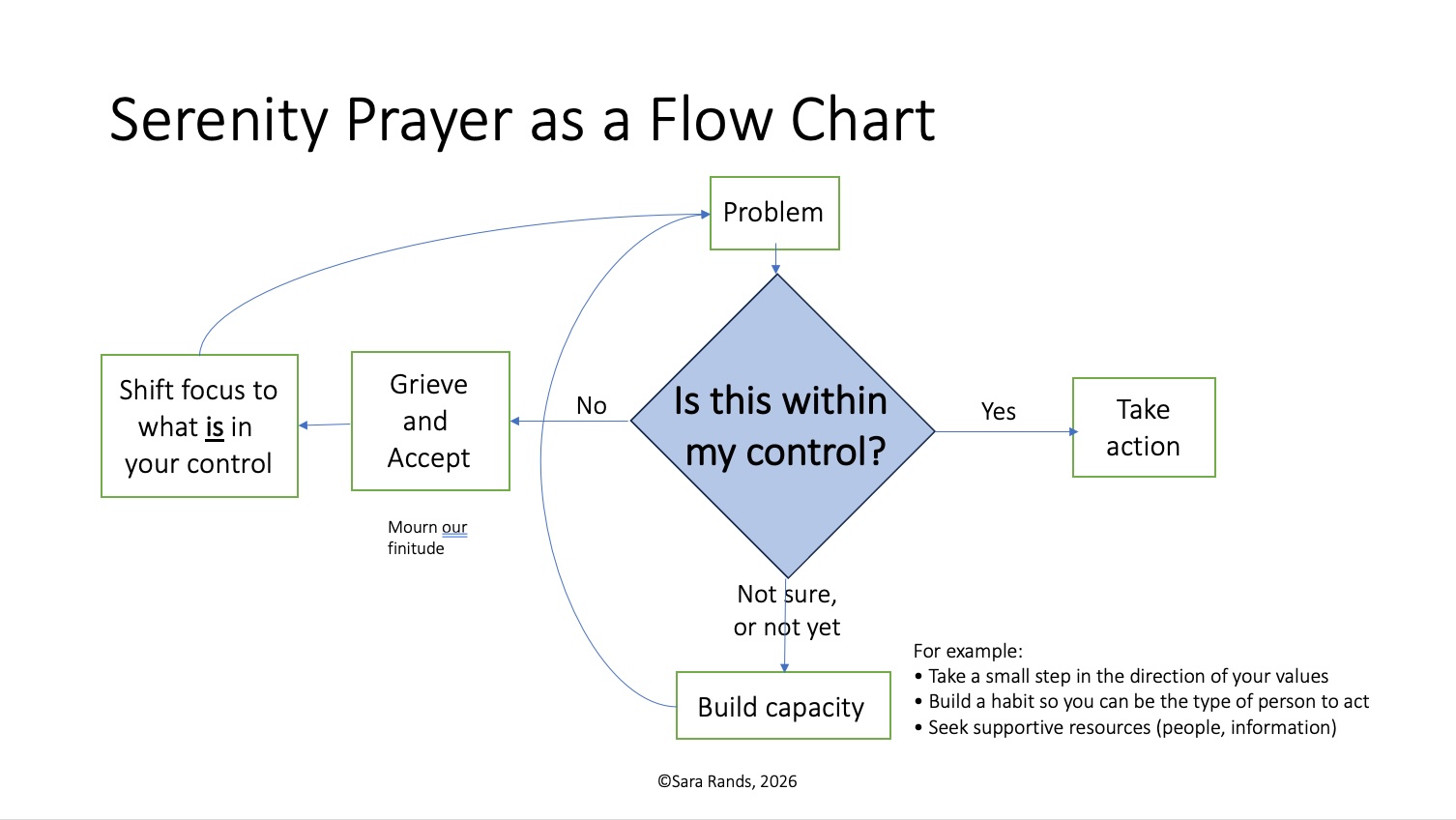
The Serenity Prayer as a flow chart
Let’s walk through it!
Problems go in.
First question: Is this under my control?
Not: should it be.
Not: is it fair.
Not: if other people behaved correctly would this be different.
Just: in the world as it exists right now, is this mine?
That question is harder than it sounds (hence “the wisdom to know the difference”). We desperately want more things to be controllable than actually are.
There are feelings here. Disappointment. Anger. Sometimes panic.
But press onward bravely.
If the answer is yes—then act.
Usually not dramatically. Not heroically. Just one small step.
Make the appointment. Have the conversation. Move the money. Stop rereading the text thread. Go for a walk. Apply for the job. Set the boundary.
Anxiety, Depression and Self-Efficacy
Action builds self-efficacy, our belief in our ability to act effectively. And self-efficacy is quietly one of the most powerful antidepressants we have.
Anxiety has “do something!” energy. This framework helps aim that energy toward something that might actually improve your life.
Depression collapses possibility. This framework helps locate one movable piece.
Grief, Acceptance, and What You Cannot Control
If the answer is no, then the work shifts.
And this is the part people hate.
If you cannot change it, then the task is grief.
Grieving the housing market. Grieving the diagnosis. Grieving the personality of someone you love. Grieving the past. Grieving that you do not get to brute-force reality into something more comfortable.
Acceptance is not approval. It is not pretending harm didn’t happen. It is facing reality as it is. Radical acceptance. And without facing reality, we cannot orient ourselves.
Eventually, after grief has done its work, attention tends to drift back to the next question:
Given reality as it is, what is still mine?
And that is where agency quietly returns.
What if you’re not sure whether something can change?
Then build capacity.
Maybe you cannot change the situation today. But you can take a small step toward becoming the kind of person who can. Learn a skill. Build a habit. Recruit allies. Strengthen your nervous system. Increase your options.
Agency is not binary. It expands with use.
The Psychology of Agency
None of this is new. Decades of research support this idea that mental health improves when our efforts align with what is under our control.
Psychology keeps rediscovering this principle under different names: self-efficacy, locus of control, learned helplessness, growth mindset, existential freedom.
Acceptance and Commitment Therapy (ACT) builds entire interventions around acceptance plus committed action aligned with values.
The NeuroAffective Relational Model (NARM), a framework I’ve been loving lately, centers adult agency as a core healing mechanism.
Even ancient Stoicism boils down to some version of this distinction.
Different centuries. Different jargon. Same core idea: when people act inside their window of control, that window tends to widen.
When people fixate exclusively on what is outside their control, their world shrinks.
I also want to say something important here.
If you feel like you don’t have choices, that probably makes sense.
There are real constraints in this world. Trauma can dramatically impact our felt sense of choices, sometimes long before we have language for what happened. Some people begin life with a much narrower slice of control than others. Privilege is real. Health problems, financial constraints, abusive systems—these are not solved by positive thinking.
Self-compassion is usually the first step.
But after compassion, it is worth asking:
Is there a sliver here that is still mine?
Even within constraints, there is often a sliver of movement. The work is learning to find it without denying the constraints.
So if you feel stuck, try running the problem through the filter.
Is this under my control?
If yes, take a small step.
If no, grieve it honestly.
Then look again.
You might be surprised how much clarity emerges.