Halfway through a Seven-Month Career Sabbatical
September 13, 2026
A colleague asked if my sabbatical was a “gap year for grownups.” I laughed, but I heard the questions underneath the joke.
Clients, fellow therapists, and friends have asked more directly. What exactly am I doing? What motivated it? Why seven months? What do you even do on a sabbatical if you’re not in academia?
I’m about halfway through now, so this seems like a good time to try to answer.
I’m using career sabbatical to mean a bounded period in which I’ve deliberately stepped away from ordinary work obligations. Not retirement. Not vacation. Not burnout recovery. Not a period with a particular product I’m supposed to deliver at the end.
A clearing, maybe: time for some things that have been deferred for years, time to explore, time to integrate several years of learning, time to experiment with how I want the next phase of my working life to be. And, underneath all of that, time to see what happens when I stop pressuring myself.
Why I took a seven-month sabbatical
Mostly because—I had an intuitive sense that I needed to.
I had just finished a long stretch of grad school, internship, associate licensure hours, trainings, and the steady pressure of getting fully licensed. Before that, the software career ran on the same fuel: self-discipline, duty. I was about to open a private practice I hope to be in for the rest of my working life. For once, there was a natural place to stop before doing the next obvious thing.
I’d also spent years ingesting ideas from the financial independence community, imagining less conventional ways of structuring work and reading others’ examples of career breaks and “mini-retirements.” So when I sensed that I needed a pause, sabbatical was already a concept I was familiar with.
There were things regular life kept pushing into the future. The biggest was interviewing my parents and working toward books of their life stories. I made life-story books for my grandparents years ago, and I’ve wanted to do the same for my parents ever since. Some things can sit on a someday list indefinitely, but this one can’t. The cancer survivor part of me knows we aren’t guaranteed any particular timeline.
I also wanted time to think about the practice I was building. The default path after licensure would have been good enough: fill a caseload, open a practice, keep going. But I know therapists who have worked with some clients for decades. If I wanted to build something that could last, it seemed worth pausing to be sure about what I’m building, before momentum built it for me.
There was a real cost to stopping. I care about my clients. Ending therapy relationships is a big deal, and I knew this from the other side. The previous year, my own therapist had taken a sabbatical. I was genuinely happy for her—even inspired, as it turns out—but I still felt a twinge of loss. I knew some of my own clients would feel some loss too. At the same time, this was the natural transition point, before I built the practice I hope to sustain for a long time.
Why seven months? Again, mostly intuition. A summer didn’t feel like enough. The rhythms of the therapy calendar offered some natural bookends, and reopening in January made sense. But mostly, seven months felt like enough room to actually shift gears.
The experiment underneath the experiment
As part of my own NARM (NeuroAffective Relational Model) therapy, I had been noticing how often I pressure myself.
Pressure has served me well. It got my children fed on Saturday mornings when I would rather have slept in. It helped me finish degrees and make career transitions and get through the long process of becoming licensed. I learned a lot of self-discipline over the years, and I’m grateful for it.
But pressure can also make it hard to hear myself. By the end of my software career, my productivity was being fueled entirely by self-discipline. I could make myself do the work, barely; it increasingly felt like whipping a horse that had nothing left to give.
If I’m always focused on making myself do the next thing, there isn’t room to notice what I want or need, or what feels alive. And those seemed vital to connect to.
I started wondering whether the thing that got me this far could take me where I wanted to go.
Before the sabbatical started, I made a whiteboard full of intentions. I might read, write, learn more music theory, work on family stories, exercise, travel, explore business ideas, deepen my clinical learning, spend time with people. But I was trying hard not to turn seven months off into a new seven-month to-do list.
The core intention I wrote down was:
Live in a way that replaces pressure with flow, and builds trust in myself.
I wanted to understand better how I work, how I feel alive. I wanted to go deeply into a few things that mattered. I wanted to spend meaningful time with my parents. I wanted movement to be part of most days. And I wanted a lot of the rest to remain available rather than mandatory.
I wrote: These are invitations, not obligations.
And underneath everything: I am not trying to do everything. I am trying to live differently.
What the space has made possible
Last week I spent several days interviewing my parents. Coordinating schedules had been harder than I expected, but when the opening appeared, I could simply go. I drove to California and spent days asking questions.
I heard stories I had never heard before, entire pieces of their lives I did not know existed. Had I not decided years ago that these stories mattered, and then allocated significant time and effort toward gathering them, I might never have known them. That alone has made me deeply grateful for this stretch of time.
The margin has mattered in other ways too. Earlier in the summer, an in-law had a medical emergency. My husband and I dropped everything and went. That wasn’t on my sabbatical intentions whiteboard, but this is why margins are useful. Emergencies happen. I want to be there for my people, if possible, when they do.
There has also been a lot of creative bubbling. I’ve written and brainstormed. I’ve had ideas for blog posts, talks, clinical work, possible projects, side businesses, and ways different pieces of my training could fit together.
I’ve done additional clinical training and had time afterward to let it settle instead of immediately stuffing more client hours around it.
Early in the sabbatical I learned that my dating skills group material had made a difference in someone’s actual real life, which got me wondering if that content should live elsewhere. I revisited those ideas for a few weeks.
One idea turned into a few weeks of collaboration with my husband: developing an open-source portal for therapists, using our software skills and newer AI tools. Unclear if it will ever see the light of day.
I started learning shorthand, and now my whiteboards have been taken over by obscure hieroglyphics.
And I started learning violin, which was not on the original list. I’ve been drawn to strings for years and had vaguely imagined trying violin “someday.” During a ketamine-assisted psychotherapy training this summer, I had an experience of music that left me wanting to engage with it differently—to play with sound, to be inside the music. So I rented a violin.
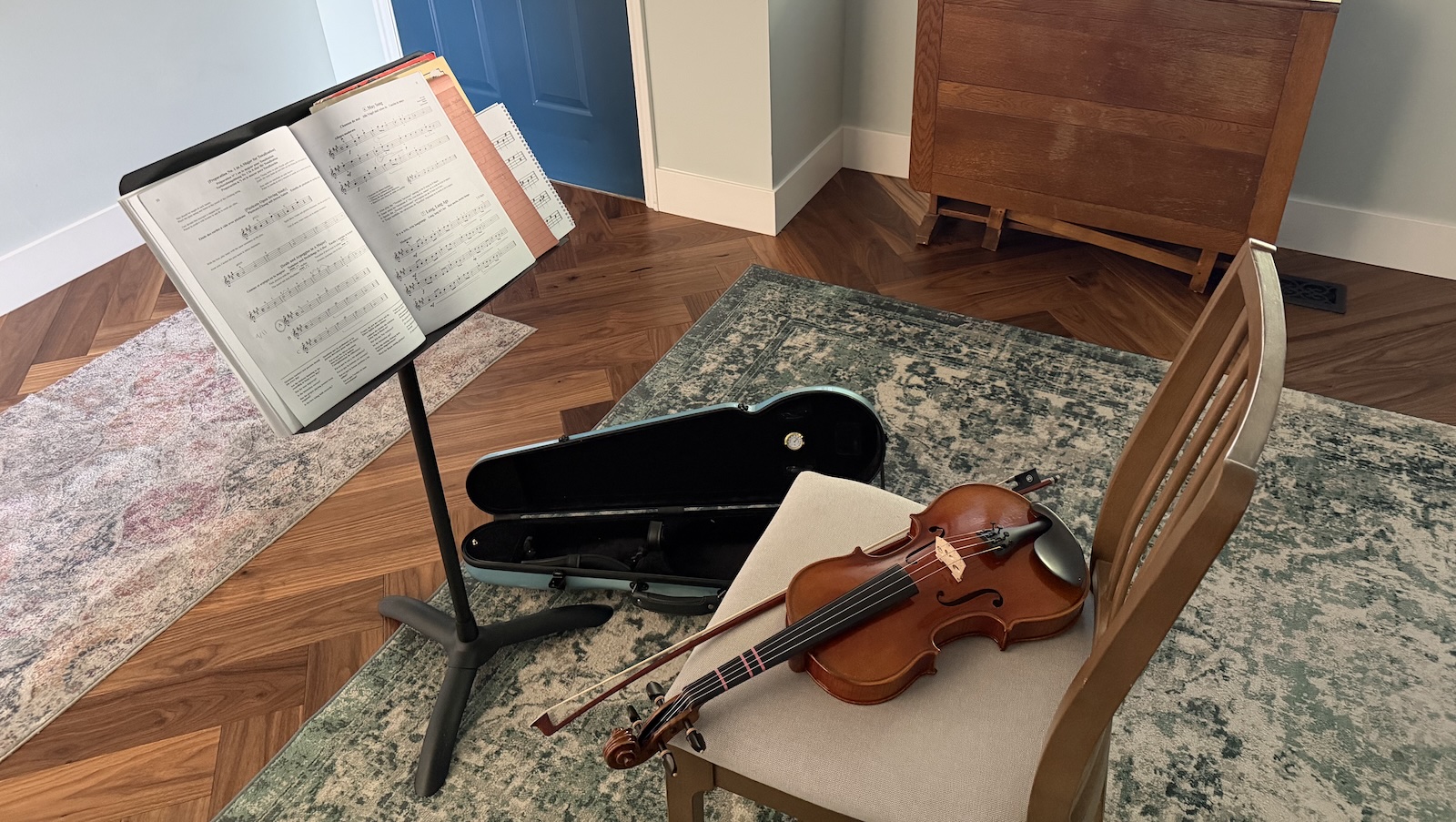
I quickly discovered that violin is not an instrument I should teach myself, so I found a teacher. It has been wonderfully fun. I’m approaching practice differently than I did music as a kid, when music was tangled up with obligation and being a good girl and doing what teachers and parents expected. Right now I am approaching it as a kind of mindfulness practice. What does it feel like to play an A-major scale badly, again and again? What is it like to move my fingers in this unintuitive way? What is it like to be a beginner?
Of course, plenty of the sabbatical is much more ordinary. I play a dumb phone game many afternoons. I still spend more time on Reddit than I want to, reading the same human dramas I have been reading for more than a decade. Sometimes I don’t walk or do pilates or eat the way I intended.
And meanwhile, quite a lot of what matters to me is happening.
What is starting to emerge
One of my hopes for the sabbatical was that I would go deep on a few things. The sabbatical itself has been more expansive than that. Lots of new things have bubbled up. But another kind of depth has started to develop: a 10,000-foot view of what I want my working life to contain.
I get this kind of perspective on long solo drives. On the recent drive to my parents’ house, I had hours alone with my thoughts and the latest Mark Manson Solved podcast about commitment and finding a life path.
Manson was discussing Kierkegaard, whom I have not read (wish I had!). The part that hit me deeply was the tension between our possibilities—all the selves we could become—and our finitude. There are so many possible lives, and, annoyingly, only one actual life in which to live them.
This has always landed hard for me in the career space. I’ve been interested in a lot of things. I went through like five college majors. I spent years as a stay-at-home mom, then became a software engineer, then a therapist. Choosing among genuinely appealing possibilities has never been easy.
So I spent a good portion of the drive overthinking all of this. Somewhere underneath the perseverating, some things bubbled up: I have a sense of what I want to commit to in my working life. Not a finalized plan—the universe is allowed to interrupt—but some longer-term intentions have become clearer.
I want deep client work. I want the possibility of knowing people over time and being part of meaningful change in their lives. I take the long-term responsibility of that seriously. That is a large part of why I’m planning an every-other-week practice structure: I want to build a container I can realistically keep offering for years.
I want to keep writing and speaking. I love putting ideas together, noticing connections and trying to make them useful to other people, presenting live and seeing how the ideas land. That gives me a way to contribute more broadly than I can one client at a time. And there is a cost to it. Writing publicly involves vulnerability, exposure, sometimes disagreement, sometimes the suspicion that I have spent several hours explaining something nobody particularly needed. I think I want to choose it anyway.
I want margin. Not whatever scraps happen to remain after the important things are scheduled, but actual space around the edges: space for creativity to emerge, for the care and feeding of this highly sensitive nervous system, for husband and children and aging parents, for travel, and for life to happen without every unexpected need becoming a scheduling problem.
I suspect my best work comes more from a sense of abundance than from scraps. I wasn’t burned out when I stopped working; my clinical work was still mostly energizing. But burnout is common in this field for a reason. It would have been easy to keep going by momentum, packing a caseload full and calling it winning. The margin is helping me see more clearly where I can contribute uniquely—both broadly, through ideas, and deeply, through individual clinical work.
I want room for bounded projects: groups, intensives, trainings, collaborations, legacy book projects, things I haven’t encountered yet. I want space to test and pursue some of these creative bubblings-up. I like the idea of doing work that matters but still has a beginning and an end.
And I want to keep following sparks within the clinical path I’ve chosen. That is largely how I got here. In grad school and afterward, I paid attention to the things that felt especially alive to me: existential work, post-religious folks, ART, NARM, ketamine-assisted psychotherapy, gifted and neurodivergent clients. Lots of things are interesting, but I am learning to focus on my tippy-top favorites.
Still in the middle
Some of these intentions may look different four months from now. Some current interests will probably disappear. Other things will undoubtedly wander into the clearing.
But the sabbatical has already given me something I wanted, even if I could not have articulated it very clearly at the beginning: room for things to be important before I know what they are for, for ideas to bubble up, for days spent asking my parents questions, for making questionable noise with the violin, and for noticing what I keep returning to. Increasingly, it is also giving me room to see what I want to give larger pieces of my finite life to.
There is still half a sabbatical left. I’m curious to see what else shows up.