On Luck, Love, and Healing
October 11, 2026
Seven years ago this week, my husband and I were internet strangers who matched on Bumble. I sent the initial message: “Recovering mathematician? I’m intrigued.”
And now we own real estate together. It’s absurd, really.
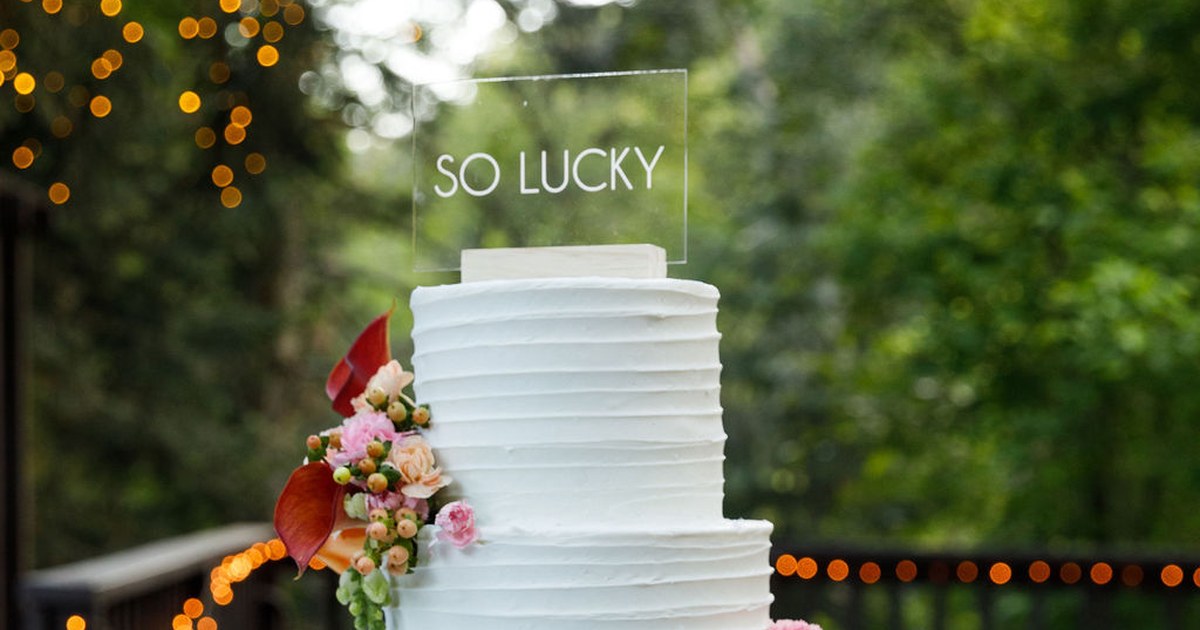
Our wedding cake had a topper that said So Lucky. We absolutely are. We won the Bumble lottery.
And yet this is a common story. Plenty of folks have won some version of the online dating lottery. By 2017, meeting online was the most common way United States heterosexual couples met. I know so many people who have found wonderful relationships in midlife.
We are lucky.
But there’s also that saying about making your own luck.
Our good fortune didn’t just fall from the sky. Before we met, we had both done healing work. We chose to put ourselves out there, and keep putting ourselves out there, even when it was uncomfortably vulnerable. And after we met, we kept creating that luck by continuing to choose each other: choosing attachment, vulnerability, partnership and commitment.
The healing power of relationships
Healthy relationships are an everyday miracle.
Not just romantic relationships. Friends, family, and community are tremendously important to human wellbeing. We saw during Covid how much we depend on each other to feel normal. We co-regulate; other people help our nervous systems settle. Being known, cared for, comforted, and paid attention to is core to mental health.
Romantic relationships are one form of connection, and when good, these are especially powerful—especially in our modern culture when extended family and community ties are less available.
There is the ordinary pleasure of having someone witness your life up close. Someone who knows you well enough to predict how you’ll react, notices when something is off, helps you find words for an experience you haven’t quite understood yourself. Over time you build a private culture: shared meals, routines, rituals, stories, ways of looking at the world, and really dumb jokes.
There is the practical partnership too: someone to think through difficult decisions with, someone invested in your work and your growth, someone with whom to build a future. You pick up the slack for one another when needed. You help with parenting, illness, loss and the other difficult moments of life. You get to see the effect of your own care on someone you love. You combine resources, social worlds, families. You support each other’s individual growth, and sometimes build things together.
I would not be a therapist today without my husband’s support and belief in me.
Underneath it all is the experience of being known. Not perfectly, not effortlessly, but increasingly well. This is attunement: the experience of being deeply seen by another person and having them respond to what they see.
Attachment theory teaches that humans develop in relationship. Babies need other people not only to feed and protect them, but to notice them, respond to them, and help them regulate experiences they can’t manage alone. As we grow, we become much more capable, but we still need each other.
Healthy adult relationships can give us thousands of experiences of being known, supported, challenged, repaired with. You get upset and find your way back to each other. You reach for someone, and, often enough, they respond.
I joke that healthy relationships can put therapists out of business in the best way.
And as a therapist, I see the process moving in both directions. Healthy relationships are healing. They can also be the result of healing. Often it becomes a virtuous circle. Doing our own work makes us more able to recognize, choose, and tolerate healthy relationships. Then the relationship itself gives us new experiences of safety, attunement, and repair, which makes more healing possible.
Making your own luck
Therapy can be one way into that virtuous circle. This can be especially useful when someone keeps finding themselves in different relationships that feel uncannily familiar. Humans have an impressive ability to recreate patterns without realizing it.
Sometimes what feels like bad luck has a pattern underneath it. We may keep choosing people who aren’t available, or stay too long in relationships that aren’t working, or dismiss good candidates too quickly, or hold such rigid ideas about attraction or compatibility that almost no one gets a real chance. Sometimes we protect ourselves from rejection so much we also protect ourselves from connection.
Now of course many wonderful people haven’t found the love they want, and not because they’ve made bad choices. That’s part of why when I was dating, I thought in terms of Plan A and Plan B. Plan A was to lean into my hope that I would re-partner and make choices that increased the chances of finding it. Plan B was to build a fulfilling single lady life that didn’t depend on a partner. I couldn’t control the outcome; I could only control my own actions.
Those two plans weren’t contradictory. Building a good single life made it easier to choose wisely in relationships.
Our patterns can be deep and surprisingly hard to see from the inside. If we want something to be different, our own behavior is usually where we have the most leverage. This shouldn’t mean looking at yourself in a blamey way, but with curiosity. A therapist can be a helpful guide along this path.
Worth wanting
I see a lot of understandable cynicism about love and relationships. Some people have built rich, connected lives and are genuinely happier single. I believe them. But I also think about people who do want a partner and have been hurt or discouraged enough that they wonder if what they want is worth wanting.
Dating can be demoralizing. Certainly online dating can be. Heartbreak is real. Vulnerability is risky.
But this time every year, I look at my life and I’m so thankful for the past version of me that made the choices that led me here.
Our relationship isn’t effortless. Sometimes it is quite effort-ful. Sometimes we annoy each other, or need space from each other, or feel misunderstood or missed emotionally. Loving an actual human means accepting a price of admission. And still, so worthwhile.
I’m grateful to be “so lucky,” and grateful that I went on those 33 terrible first dates before meeting him and endured the emotional turmoil that went along with that.
Two years ago, on our 5th Bumble anniversary, this same gratitude led me to gather some hard-won learnings about dating, and combine it with what I know as a therapist about confidence, courage, vulnerability, attachment, and how people change. I turned it into a dating skills group. Those ideas may eventually find their way onto this blog.
One of the most powerful moments in that group was listening to Adam Driver’s performance of “Being Alive” in Marriage Story. The song starts with everything difficult about letting someone into your life. Other people are inconvenient, make demands, have expectations, can get close enough to hurt us. But then the song turns to wanting that closeness: to be deeply known, affected, held.
The line that always gets me is: “Want something.” If partnership is something you actually want, let yourself want it. Then get curious about what that desire asks of you.
Luck matters, and our choices matter. Healthy relationships heal, and healing makes healthy relationships more possible. And love really is worth the trouble.